
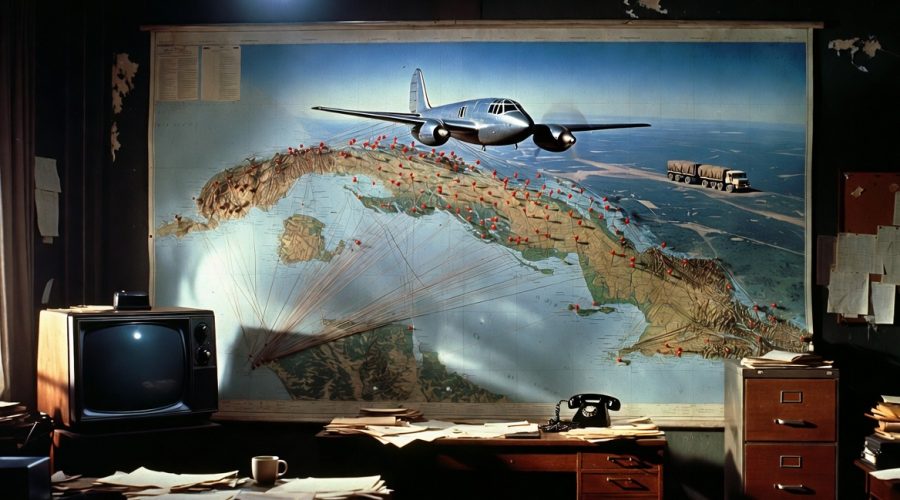
At three in the morning, in a basement office at the Pentagon, an Air Force brigadier general typed out a six-phase timetable for overthrowing a country. Phase I: start moving in. Phase V: open revolt. Phase VI: establishment of a new government, October 1962. Edward Geary Lansdale had stage-managed coups in Manila and Saigon. He did not joke about dates. The country was Cuba. The deadline was eight months away.
On November 30, 1961, John F. Kennedy signed a top-secret memorandum, drafted by national security adviser McGeorge Bundy and addressed to seven men, that authorized the most extensive U.S. intelligence campaign ever conducted inside a Communist state during the Cold War.[1] It established a supervising body called the Special Group (Augmented). It named Lansdale chief of operations. It put the attorney general — the president’s 36-year-old brother — in the chair. And it stated the project’s purpose in nine bland words: “to help Cuba overthrow the communist regime.”[2]
What followed, between November 1961 and the spring of 1965, was a sprawling, expensive, often deranged secret war against a country of seven million people ninety miles south of Florida. The CIA station built to run it became the largest intelligence facility on earth outside Langley. Its annual budget reached roughly $50 million in 1962 dollars — more than half a billion in today’s money. It paid 15,000 Cuban exiles, ran three or four hundred case officers, and floated what was, by some counts, the third-largest navy in the Caribbean.[3] It rigged sugar mills to explode, contracted Mafia bosses to arrange assassinations, slipped poison pellets to mistresses, and at one moment in March 1962 — formally submitted to the Secretary of Defense — proposed staging terrorist bombings in American cities to manufacture a pretext for invasion.[4]
None of it killed Castro. He lived to be 90. What the secret war did do was push Khrushchev to install nuclear missiles in Cuba, bring the world closer to thermonuclear extinction than at any moment before or since, and bequeath every U.S. administration from Johnson onward an irreconcilable enemy ninety miles from Florida. The documentary record was buried for thirty-five years. This is the story of what Mongoose tried to do, what it did instead, and why the bill has never been paid.
- When: November 30, 1961 — April 7, 1964 (formal end of sabotage operations)
- Where: Cuba; JMWAVE station, Miami; SGA meetings, Washington
- Who: Brig. Gen. Edward Lansdale (Chief of Ops), Robert F. Kennedy (SGA chair), William Harvey (Task Force W), Ted Shackley (JMWAVE chief)
- Scale: ~$50 million annual budget (more than half a billion in today’s dollars), ~15,000 paid Cuban exile operatives, 300–400 CIA case officers
- Plots: 8 assassination attempts on Castro substantiated by the 1975 Church Committee; 638 schemes claimed by Cuban counterintelligence
- Declassification: Church Committee disclosures 1975; Operation Northwoods documents November 1997; ~1,000 pages of additional records 1997–2001
I — The Bay of Pigs Crater
The plan, code-named Zapata, had been hatched under Eisenhower and inherited by Kennedy a few weeks after his inauguration. On the morning of April 17, 1961, roughly 1,400 Cuban exiles — Brigade 2506, trained and equipped by the CIA — waded ashore at the Bay of Pigs. Within forty-eight hours Castro’s forces had killed more than a hundred of them, captured 1,200, and shot down or sunk most of their air and naval support. Four American pilots flying CIA-contracted B-26s died alongside them.[5]
Publicly Kennedy took responsibility. Privately he raged. He fired CIA Director Allen Dulles and Deputy Director Richard Bissell. He commissioned a postmortem from retired Army Chief of Staff Maxwell Taylor, who concluded that there could be “no long-term living with Castro.”[6]
Robert Kennedy, the new attorney general, needed no convincing. He had been blindsided by the Bay of Pigs briefings. He would not be blindsided again. The Cuba portfolio passed, by his brother’s design, into his hands. The invasion itself has been told in granular detail elsewhere — most accessibly in Jim Rasenberger’s The Brilliant Disaster. Its political consequence for the story that follows is simple: it convinced both Kennedys that the next operation had to be smaller, more covert, deniable — and run from a desk they could see.
II — November 1961: The Cuba Project Is Born
Through the summer and autumn of 1961, the administration absorbed the lessons of the Bay of Pigs in the form of a continuous low-level paramilitary effort against Cuba. The CIA ran a black-propaganda outlet called Radio Swan; it maintained scattered exile commandos in South Florida; it had a handful of agents in Havana. None of it was producing anything. On November 3, 1961, a meeting at the White House decided this would not do. The operation acquired its name the following day — a mongoose, the small Indian predator famous for killing cobras.[7]
On November 30, McGeorge Bundy circulated the authorizing memorandum to seven men. It established the Special Group (Augmented). It named Lansdale chief of operations. It restricted knowledge of the programme to those seven, the SGA members, and their designated representatives.[2] The entire United States government’s covert war against Cuba was, at that moment, a black box known to fewer than two dozen people.
The Cast
Lansdale was 53, a former advertising executive who had spent the 1950s running counterinsurgency in the Philippines and South Vietnam. His admirers — President Kennedy among them — saw a brilliant unconventional warrior who had defeated the Huk rebellion. His detractors saw a self-promoting fabulist who was widely (though Greene himself denied it) believed to be the model for Alden Pyle in Graham Greene’s The Quiet American.[8] Both views were partly right.
At the CIA, the field commander was William King Harvey — 47, overweight, paranoid, known for keeping a revolver on his desk during meetings. Harvey ran Task Force W, the agency’s Cuba unit. He thought Lansdale was a crank, and the feeling was mutual. The Special Group (Augmented) met every Thursday morning in Bundy’s West Wing office. Robert Kennedy chaired. CIA officer Samuel Halpern later put it bluntly: “It was a government-wide operation run out of Bobby Kennedy’s office with Ed Lansdale as the mastermind.”[1]

III — “All Else Is Secondary”
On January 19, 1962, in a windowless conference room at the CIA’s Washington headquarters, Robert Kennedy delivered what amounted to a pep talk to the Mongoose staff. According to a memorandum written by Richard Helms, who was in the room, the attorney general told the assembled officers that overthrowing Castro represented “the top priority of the U.S. government — all else is secondary — no time, money, effort, or manpower is to be spared.”[9]
From that moment forward, no senior official in Washington could plead lack of resources for missing a Mongoose deadline. Whether or not Robert Kennedy ever explicitly ordered assassination — a question historians have argued over for fifty years — he made it impossible for anyone below him to suggest an option was off the table because it was too aggressive.
“The solution to the Cuban problem today carries the top priority in the U.S. government — all else is secondary — no time, money, effort or manpower is to be spared.” — Attorney General Robert F. Kennedy, addressing Mongoose officers, January 19, 1962. Memorandum by Richard Helms, declassified by the Church Committee. Share this on X
Within four weeks, Lansdale had a plan.
IV — The Six Phases
Edward Lansdale’s “Program Review by the Chief of Operations, Operation Mongoose,” dated February 20, 1962, runs to 39 pages of single-spaced planning. Classified Top Secret / Sensitive, it laid out a six-phase schedule that would, in Lansdale’s confident phrasing, climax in “open revolt and overthrow of the Communist regime” during the first two weeks of October 1962.[10]
The phases were touchingly bureaucratic in their precision: Phase I (March 1962), start moving in; Phase II (April–July), build-up of political action, economic warfare, sabotage support, paramilitary infiltration; Phase III (August), readiness check; Phase IV (August–September), guerrilla operations; Phase V (first two weeks of October), open revolt; Phase VI (October), establishment of a new government.[10]
The plan rested on a single premise: that the Cuban people, given a credible rallying point, would rise against Castro the way Americans had once risen against George III. “Americans once ran a successful revolution,” Lansdale wrote, almost wistfully. This was, to put it gently, a misreading of the Cuban revolution. Castro’s regime, three years into power, retained massive popular support. The CIA’s own National Intelligence Estimate had already concluded as much. Robert Kennedy, briefed on it, had brushed it aside.[11]
V — JMWAVE: The Third-Largest Navy in the Caribbean
The operational headquarters of Mongoose was not in Washington. It was in Miami — on the South Campus of the University of Miami, a tract of pine-scrub land south of the Metrozoo that had once been the Richmond Naval Air Station. Building 25, a two-story concrete blockhouse, sat behind a front-door sign reading “Zenith Technical Enterprises.” Behind that door was the largest CIA station in the world outside Langley.[3]
JMWAVE — the agency’s cryptonym for the Miami station — had been growing since shortly after the Bay of Pigs. By spring 1962, under station chief Theodore Shackley (a 35-year-old Berlin veteran nicknamed “the Blond Ghost”), it employed between 300 and 400 case officers running roughly 15,000 Cuban exiles at $175 a month plus family supplements. The annual budget reached approximately $50 million.[3]
A Private Navy
The station maintained more than a hundred boats, ranging from V-20 fast craft to the 174-foot mothership Rex, equipped with 40-millimeter and 20-millimeter cannons. Air support came from tactical fighter aircraft based at nearby Homestead Air Force Base, including F-100 Super Sabres. At its peak, Cuban veterans of the era have estimated, the JMWAVE fleet constituted the third-largest navy in the Caribbean, surpassed only by the U.S. and Cuban navies themselves.[12]
Front companies — at one point numbering between 300 and 400 — provided cover for safe houses, training facilities, weapons caches, and operative payments. The real-estate, banking, and certain manufacturing sectors of Miami-Dade County experienced what historians of the period politely call a Cold War “boom.” JMWAVE’s existence was an open secret to every police chief and county judge in South Florida; it took until June 26, 1964, for Look magazine to publish the first major exposé. The agency promptly changed the front-company name from Zenith to Melmar Corporation and carried on.[3]
VI — Sugar Mills and Smokestacks
The operational record of Mongoose, reconstructed from declassified files by Harvard historian Jorge Domínguez and others, reads like a logistics manifest. CIA-trained Cuban exile commandos infiltrated the island by submarine, fast boat, and parachute. They attacked a railway bridge. They blew up petroleum storage facilities. They burned a molasses container. They damaged a sugar refinery and a sawmill. They set fire to a floating crane in a Cuban harbour. On November 8, 1962 — days after the public end of the Missile Crisis — a six-man sabotage team destroyed a Cuban industrial facility.[13]
Lansdale’s own July 1962 progress report admitted that 19 maritime infiltration missions had aborted by the end of Phase I. Eleven teams were supposed to have been inserted by the end of July; four supply caches had been planted; one supply mission of 1,500 pounds had succeeded. Sabotage, where it occurred, had often been initiated by the exiles themselves.[14]
October 4: “There Should Be Considerably More Sabotage”
The frustrations boiled over at a Special Group meeting on October 4, 1962. Robert Kennedy, increasingly impatient, presided. The declassified minutes contain an underlined line: “there should be considerably more sabotage.” Plans were discussed for attacks on a Cuban electric power plant, an oil refinery, and a sugar mill. Three of ten six-man sabotage teams were being readied for deployment.[1] What no one in the room knew was that for nearly six weeks, the Soviet Union had been moving medium-range R-12 nuclear missiles to Cuba. On October 14, a U-2 overflight brought back the photographs that would, eight days later, push the world to the edge of nuclear war.
VII — March 13, 1962: The Day the Generals Lost Their Minds
The most disturbing document declassified from the Mongoose archives was not produced by the CIA. It was produced by the Pentagon. On March 13, 1962, the Chairman of the Joint Chiefs of Staff, General Lyman Lemnitzer, signed and forwarded to Secretary of Defense Robert McNamara a Top Secret memorandum titled “Justification for U.S. Military Intervention in Cuba.” Its working name was Operation Northwoods.[4]
The document was the Joint Chiefs’ considered reply to a question Lansdale had asked them on behalf of the Cuba Project: produce a “brief but precise description of pretexts” that would justify American military intervention. The generals’ response ran to dozens of pages. The proposals included staging real terrorist attacks against Cuban exile communities in Miami and Washington and blaming them on Castro; sinking boatloads of Cuban refugees on the high seas; bombing campaigns in U.S. cities (“We could develop a Communist Cuban terror campaign in the Miami area, in other Florida cities and even in Washington”); a faked attack on Guantánamo Bay using friendly Cubans in Cuban uniforms; the repainting of an Air Force aircraft as a Cuban MiG and the staged shoot-down of a chartered civilian airliner full of college students; the blowing up of an American warship in Guantánamo Harbor “à la Maine.”[15]
“It is possible to create an incident which will demonstrate convincingly that a Cuban aircraft has attacked and shot down a chartered civil airliner en route from the United States to Jamaica, Guatemala, Panama or Venezuela. The destination would be chosen only to cause the flight plan route to cross Cuba. The passengers could be a group of college students off on a holiday… The actual registered aircraft would be converted to a drone.” — Joint Chiefs of Staff, “Justification for U.S. Military Intervention in Cuba (TS)”, March 13, 1962. Declassified November 1997. Share this on X
A separate sub-memo, Operation Dirty Trick, proposed that if astronaut John Glenn’s Mercury orbital flight failed, the Joint Chiefs would manufacture evidence of Cuban electronic sabotage to justify retaliation.[15]
Kennedy in the Room
On March 16, 1962 — three days after Lemnitzer signed Northwoods — Lansdale brought the senior Mongoose principals to the Oval Office. According to his memorandum for the record, “General Lemnitzer commented that the military had contingency plans for U.S. intervention. Also, it had plans for creating plausible pretexts to use force.” Kennedy, the memo records, replied “bluntly that we were not discussing the use of military force.” In September 1962 he declined to reappoint Lemnitzer to a second term as JCS chairman; in January 1963 the general was shuffled sideways to NATO. He died in 1988, nine years before the documents bearing his signature were declassified.[4]
VIII — The Mafia Contract
If Northwoods was the most disturbing scheme in the Pentagon’s filing cabinet, the most baroque schemes belonged to the CIA. By the time Mongoose was authorized, the agency was already running assassination plots against Castro that had begun under Eisenhower. The Church Committee, in its 1975 interim report Alleged Assassination Plots Involving Foreign Leaders, formally substantiated eight such plots between 1960 and 1965. The CIA’s own Inspector General had detailed many of them in a 1967 report — kept secret until 1993.[17]
The most consequential involved organized crime. In September 1960, CIA Deputy Director for Plans Richard Bissell reached out — via agency link man Robert Maheu — to two senior Mafia figures: Chicago boss Sam Giancana and Tampa kingpin Santo Trafficante Jr. The Mob, having lost its Havana casinos to Castro’s revolution, had both means and motive. On March 12, 1961, just five weeks before the Bay of Pigs, Maheu met with Giancana, Trafficante, and freelance mafioso Johnny Roselli at the Fontainebleau Hotel in Miami Beach to hand over poison pills for a Cuban contact close to Castro. The pills never reached their target. The contract continued under Mongoose; Harvey was named the agency’s case officer for Roselli in May 1962.[18]
The agency’s Technical Services Division, headed by chemist Sidney Gottlieb, generated a near-endless catalogue of assassination ideas: cigars laced with botulinum toxin (a box was prepared and delivered to Havana); a fungus-impregnated wetsuit, to be presented to Castro by attorney James Donovan during prisoner-exchange negotiations; an explosive seashell on the sea floor at a known diving site; thallium salts in his shoes, to make his beard fall out; a ballpoint pen rigged with a hypodermic loaded with industrial pesticide Black Leaf 40.[17]
The internal politics of these plots — what the brothers Kennedy knew, what they authorized, what they conveniently failed to ask — remains the most contested terrain in Cold War intelligence history. In Brothers in Arms, journalists Gus Russo and Stephen Molton argue from thirty years of archival work that Robert Kennedy was deeply complicit, and that the assassination of his brother in Dallas cannot be understood apart from Mongoose. Other historians have argued the documentary record stops short of personal authorization. What is no longer disputed is that the plots existed, that the agency executed them, and that they continued well after Mongoose was formally suspended.
IX — The Mongoose Brings the Missiles
For forty years, the standard American account of the Cuban Missile Crisis presented the Soviet deployment as an opportunistic gamble by an aggressive Khrushchev. The declassification of Mongoose has replaced that story with a more uncomfortable one.
Khrushchev himself, in his memoirs and in subsequent statements by Soviet and Cuban officials at academic conferences in Havana between 1989 and 2002, said the missile decision was driven first and foremost by fear of an imminent American invasion of Cuba.[19] Castro, in one of those same conferences with Robert McNamara in attendance, made the same point in plainer terms: the missiles came in because the Cubans believed an invasion was coming, and the Soviets agreed to prevent it.
They were not paranoid. Operation Northwoods existed. Phase V of the Mongoose plan was scheduled for the first two weeks of October. Between October 14 and the public end of the crisis on October 28, the U.S. Navy conducted a long-planned amphibious exercise on Vieques Island, Puerto Rico — PHIBRIGLEX-62, also known as Operation Ortsac — involving 20,000 naval personnel and 4,000 marines rehearsing the overthrow of a fictitious tyrant whose name was Castro spelled backwards.[20] Whether or not the Kennedy administration ever intended to invade is, in some sense, beside the point. The Cubans and the Soviets believed it intended to. The missiles were the answer.
On October 30, 1962, Robert Kennedy ordered Mongoose suspended. By that date, three of ten six-man sabotage teams had already landed in Cuba.[13]
The Bargain at the Edge
The thirteen days ended with a public agreement — the Soviets would withdraw their warheads, the United States would publicly pledge not to invade Cuba — and a secret one, in which Washington also agreed to withdraw its Jupiter missiles from Turkey. The no-invade pledge became the cornerstone of Castro’s survival. It was also a quiet humiliation for Mongoose. The president had pledged, in writing, not to do the thing Mongoose had been designed to enable.
The pledge did not stop the sabotage. Operations resumed within months under a reconstituted SGA, now known as the Special Group / 303 Committee. From June 1963 onward, the campaign intensified: the CIA received authorization for thirteen major new operations, including attacks on a power plant, an oil refinery, and a sugar mill. JMWAVE remained at full strength.[13] The mongoose, having brought a thermonuclear war to within minutes of detonation, returned to its routine.
X — AMLASH and the Pen in Paris
Of all the assassination plots that survived Mongoose, the most consequential targeted Castro through a man inside his own circle. Major Rolando Cubela Secades — code-named AMLASH — was a senior officer of the Cuban Directorio Revolucionario, the student-resistance group that had fought Batista alongside the July 26 Movement. By 1961 he had grown disillusioned with the regime’s communist turn. The CIA cultivated him for two years. In September 1963, in Porto Alegre, Brazil, he told case officer Nestor Sánchez he was ready to kill Castro personally, but needed a high-velocity rifle with a silencer and an assurance of U.S. support.[21]
In Paris on the afternoon of November 22, 1963, Sánchez met Cubela in a CIA safe house. The purpose was to deliver the assassination weapon — a Paper-Mate ballpoint pen fitted with a fine hypodermic needle, charged with Black Leaf 40 insecticide. Sánchez handed it over. Cubela was unimpressed; he had asked for the rifle. He took the pen anyway. Sánchez and Cubela were still in the safe house when the cable arrived from headquarters. President John F. Kennedy had been shot in Dallas by a 24-year-old former Marine who had recently been head of the New Orleans chapter of the Fair Play for Cuba Committee.[21]
The Coincidence That Wasn’t
The simultaneity has never been fully resolved. AMLASH continued as a CIA project under Johnson; the agency’s contact with Cubela ran until June 1965, when, having decided the operation was too widely known, headquarters ordered all contact terminated. On February 28, 1966, Castro summoned Cubela to his office and arrested him. The trial at La Cabaña fortress the following month did not refer to Cubela’s CIA contacts before late 1964 — a curious omission. Cubela faced execution; in a letter to the prosecutor on March 9, Castro personally requested that the death penalty not be imposed. Cubela received 25 years; he was released in 1979 and exiled to Spain. He died in a Miami nursing home in August 2022, age 89.[22]
XI — The Long Burial
Lyndon Johnson, briefed on the Cuba operations within hours of taking office, was less enthusiastic about Mongoose than the brothers had been. He kept the sabotage going for sixteen more months. On April 7, 1964, he ordered it formally ended. JMWAVE remained operational until 1968.[3]
The operation entered public consciousness gradually. In 1974 and 1975, in the wake of Watergate, Senator Frank Church of Idaho chaired a Senate select committee whose hearings produced the first official confirmation that the CIA had repeatedly tried to murder Castro.[17] In direct response, President Gerald Ford signed Executive Order 11905 in 1976, prohibiting any U.S. government employee from engaging in political assassination. The Hughes-Ryan Act of 1974 required, for the first time, that all CIA covert operations be reported to relevant congressional committees.
1997–2001
The bulk of the Mongoose record surfaced two decades later. In November 1997 the John F. Kennedy Assassination Records Review Board declassified the Operation Northwoods documents, releasing 1,521 pages of Joint Chiefs records. In 2001 the National Security Archive published the most complete Northwoods text available, along with hundreds of pages of related Lansdale memoranda and Special Group minutes.[16] Tim Weiner’s Legacy of Ashes, the standard institutional history of the CIA, drew on these releases and the Church Committee record to reconstruct the operation in its first comprehensive form.
What the documentary record makes clear is something that, for decades, was treated as the speculation of paranoids. Between November 1961 and the spring of 1965 the United States government ran the largest sustained international sabotage and assassination programme of the Cold War. Noam Chomsky has called it the largest international terrorism operation of its era. The phrase is contested; the documentation is the federal government’s own.[23]
The File
| Codename (US) | Operation Mongoose / The Cuba Project |
|---|---|
| Authorized | November 30, 1961, by Pres. John F. Kennedy via memorandum drafted by McGeorge Bundy |
| Chief of Operations | Brig. Gen. (later Maj. Gen.) Edward G. Lansdale, USAF |
| CIA Field Commander | William K. Harvey, head of Task Force W |
| Oversight | Special Group (Augmented), chaired by Att. Gen. Robert F. Kennedy |
| Operational Base | CIA Station JMWAVE, University of Miami South Campus, Florida |
| Annual budget | ~$50 million (1962 USD); more than half a billion in today’s dollars |
| Personnel | 300–400 CIA case officers; ~15,000 paid Cuban exiles; 100+ vessels |
| Castro assassination plots | 8 substantiated by the 1975 Church Committee; 638 schemes claimed by Cuban counterintelligence |
| Suspended | October 30, 1962, during the Cuban Missile Crisis |
| Formally ended | April 7, 1964, by Pres. Lyndon B. Johnson (sabotage operations) |
| Key declassifications | 1975 (Church Committee), 1993 (CIA Inspector General’s 1967 report), Nov. 18, 1997 (Operation Northwoods), 2001 (National Security Archive) |
Coda — Why It Still Matters
Mongoose is, on its face, a story about Cuba. It is also a story about what an unsupervised national-security state will do when a president tells it that overthrowing a small foreign government is the most important thing in the world.
It is difficult to read the declassified Northwoods documents — written by men who had won the Second World War, who held the highest uniforms in the United States, who would be paid full pensions and die with full honors — and not feel a kind of vertigo. They proposed bombing American citizens. They proposed sinking refugee boats. They put it in writing. They were not prosecuted; most were promoted. Lemnitzer went to NATO. Shackley went on to Laos and then Saigon. Lansdale was sent back to Vietnam.
The longer consequence is easier to count. Castro stayed in power for forty-seven years before handing the presidency to his brother Raúl. The Cuban embargo — instituted in part to enable the Mongoose strategy — remained, when it finally began to soften under President Obama in 2014, the longest-running trade sanctions regime in the modern world. Every U.S. president from Kennedy onward inherited Mongoose’s strategic failure. No formal apology has ever been issued.
The deepest legacy of Mongoose, however, is not in Havana. It is in the institution that ran it. Every subsequent CIA covert action has carried, in its DNA, the lessons of the secret war against Cuba. So has every effort by Congress, the press, and the public to subject the agency to accountability. The Hughes-Ryan Act, the Senate and House intelligence committees, the executive ban on political assassination — all of them trace, by direct lineage, to Building 25 in Miami and a Thursday-morning conference in the West Wing.
Castro outlasted ten American presidents. The mongoose died first. The file, finally, is on the table.
References
- “Operation Mongoose.” Wikipedia. Comprehensive synthesis of declassified U.S. records. Link
- U.S. Department of State, Office of the Historian. Foreign Relations of the United States 1961–1963, Volume X, Cuba 1961–1962, Document 278: Memorandum from President Kennedy to Senior Officials, November 30, 1961. Link
- “JMWAVE.” Wikipedia. Drawing on Don Bohning, The Castro Obsession, Potomac Books, 2005. Link
- “Operation Northwoods.” Wikipedia. Built from the JFK Assassination Records Review Board declassification of November 18, 1997. Link
- U.S. Department of State, Office of the Historian. “The Bay of Pigs Invasion and its Aftermath, April 1961–October 1962.” Link
- Maxwell D. Taylor et al., “Report of the Cuba Study Group” (the “Taylor Report”), June 13, 1961, declassified portions in FRUS 1961–1963, Volume X. Link
- National Security Archive, George Washington University. “Kennedy and Cuba: Operation Mongoose.” Briefing Book No. 687, edited by John Prados, October 3, 2019. Link
- “Edward Lansdale.” Wikipedia. Link
- PBS American Experience. “Operation Mongoose.” Link · The “top priority” quote is also reproduced in U.S. Senate, Select Committee to Study Governmental Operations with Respect to Intelligence Activities (the “Church Committee”), Interim Report: Alleged Assassination Plots Involving Foreign Leaders, S. Rep. 94-465, November 20, 1975.
- FRUS 1961–1963, Volume X, Document 304: Program Review by the Chief of Operations, Operation Mongoose (Lansdale), February 20, 1962. Link
- National Security Archive. “Memorandum from Brigadier General Edward Lansdale to the President, Attorney General, Special Group et al., ‘The Cuba Project,’ February 20, 1962.” Link
- John Simkin. “JM-WAVE: History.” Spartacus Educational. Link
- Jorge I. Domínguez, “The @#$%& Missile Crisis (Or, What was ‘Cuban’ about US Decisions during the Cuban Missile Crisis),” Diplomatic History, Vol. 24 No. 2, Spring 2000, pp. 305–315; summarized in “Cuban Project,” Military Wiki. Link
- National Security Archive Briefing Book No. 687, op. cit., document selection (Lansdale July 1962 Program Review of Phase I). Link
- National Security Archive, “Pentagon Proposed Pretexts for Cuban Invasion in 1962” (Operation Northwoods document release), April 30, 2001, edited by Jon Elliston and Peter Kornbluh. Link
- James Bamford, Body of Secrets: Anatomy of the Ultra-Secret National Security Agency, Doubleday, 2001 — first major journalistic treatment of Northwoods.
- U.S. Senate Church Committee, Alleged Assassination Plots Involving Foreign Leaders, S. Rep. 94-465, November 20, 1975; “CIA assassination attempts on Fidel Castro,” Wikipedia. Link
- CIA Inspector General’s Report on Plots to Assassinate Fidel Castro (1967), declassified 1993. Summary at CNN, “Assassination plots and schemes: Castro in the crosshairs.” Link
- Nikita Khrushchev, Khrushchev Remembers, trans. Strobe Talbott (Little, Brown, 1970), pp. 488–505; James G. Blight, Bruce J. Allyn, and David A. Welch, Cuba on the Brink: Castro, the Missile Crisis, and the Soviet Collapse, Pantheon, 1993.
- “Operation Ortsac.” Wikipedia; Michael Dobbs, One Minute to Midnight, Knopf, 2008. Link
- FRUS 1964–1968, Volume XXXII, Document 315: Project AMLASH file summary. Link
- “Rolando Cubela Secades.” Wikipedia. Link · Jefferson Morley, “CIA Assassin in Castro Plots Dies,” Sri Lanka Guardian, August 2022.
- Noam Chomsky, “The U.S. and Cuba: 1959 and the Mongoose,” quoted in academic syntheses of the declassified record; see “Cuban Project,” en-academic.com. Link
Further reading
- Brothers in Arms: The Kennedys, the Castros, and the Politics of Murder by Gus Russo and Stephen Molton
- The Brilliant Disaster: JFK, Castro, and America’s Doomed Invasion of Cuba’s Bay of Pigs by Jim Rasenberger
- Legacy of Ashes: The History of the CIA by Tim Weiner
- Body of Secrets by James Bamford — the first major journalistic account of Operation Northwoods
Some of the links above are affiliate links. If you make a purchase through them, I may earn a small commission at no extra cost to you. Thank you for supporting Decoding History.