In four sweltering August days, a handful of American and British spies, suitcases of cash, paid mobs, and one insubordinate cable rewrote the modern Middle East. Seventy-three years later, the receipts are finally on the table.
On August 19, 1953, the elected prime minister of Iran was dragged from power by a coup organized in a basement office of the United States embassy in Tehran. The man running it was a soft-spoken, bespectacled grandson of Theodore Roosevelt named Kermit “Kim” Roosevelt Jr. The man being overthrown was Mohammad Mossadegh — a 71-year-old aristocrat-turned-nationalist whom TIME magazine had named its Man of the Year only nineteen months earlier. Almost 300 people died in firefights in the streets of Tehran that day.[3] Mossadegh was tried for treason and spent the rest of his life under house arrest. The young Shah, who had fled to Rome in his pajamas convinced his throne was lost, was flown back to Tehran and ruled as an absolute monarch for the next twenty-five years.[1]
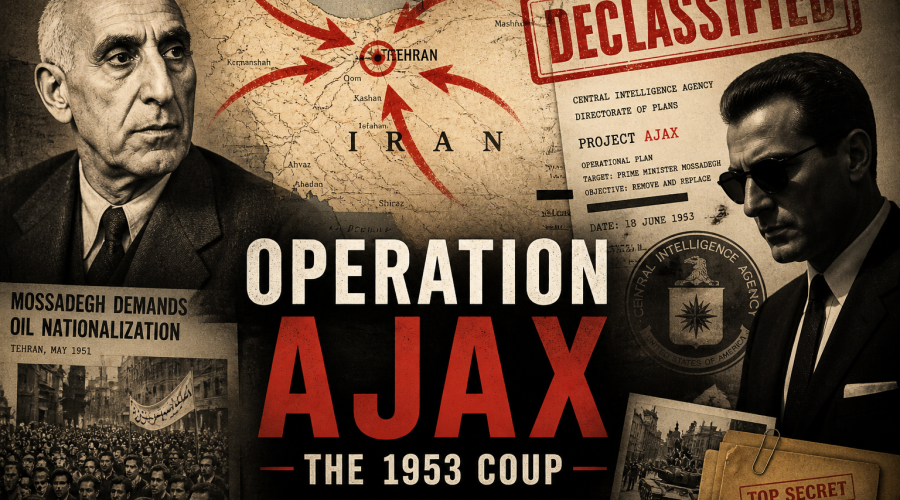
The operation was code-named TPAJAX by the CIA and “Operation Boot” by Britain’s MI6.[1] For sixty years it was Washington’s worst-kept secret. The CIA finally admitted its role in 2013, and in 2017 the State Department released roughly a thousand pages of cables and memos that confirmed in clinical detail what Iranians had been saying for decades.[2][5] This is the full story of how it happened, why it happened, and why almost every headline coming out of Tehran today still echoes the events of those four days.
I — A Country Built on Other People’s Oil
To understand why Mossadegh terrified London and Washington, you need to understand what the Anglo-Iranian Oil Company (AIOC) actually was. It was not, despite the name, a private business in any meaningful sense. The British government had owned 51% of the company since 1914, when Winston Churchill, as First Lord of the Admiralty, convinced Parliament that the Royal Navy’s switch from coal to oil required guaranteed access to Persian crude.[7] The company sat on top of Iran’s economy like a sovereign state. It built its own city at Abadan — by 1951, the largest oil refinery on earth — with strict racial segregation between British managers in landscaped garden suburbs and Iranian workers in slum quarters.[8]
The financial arrangement was equally lopsided. Between 1945 and 1950, the AIOC’s net profits were nearly three times the royalties it paid to the Iranian government.[9] By the late 1940s, Britain was earning more in tax revenue from the AIOC than Iran earned from the entire concession.[6] When Iranian negotiators asked simply to audit the company’s books — to verify that the contracted royalties were actually being paid — the AIOC refused.[1][6]
Across the Persian Gulf, things were changing. In 1950, the American oil company Aramco signed a 50/50 profit-sharing deal with Saudi Arabia. Iranian nationalists looked at that deal and asked the obvious question: why not us?[9] The British answer, in essence, was that Iranian oil was British oil — discovered, developed, and rightfully exploited by British capital. Some senior officials in Whitehall genuinely believed this even into the 1950s.[8]
II — The Pajama Premier
Mohammad Mossadegh was an unlikely revolutionary. Born in 1882 into the Qajar aristocracy, related on his mother’s side to the ruling royal family, he held a doctorate in law from the University of Lausanne and had served as governor, finance minister, and parliamentarian under multiple regimes.[10] He was famous for working from his bed, conducting cabinet business in pajamas, and weeping in parliament. TIME dismissed him as a “dervish in pin-striped suit.” Western diplomats found him exasperating. Iranians found him incorruptible.[10]
By 1949, Mossadegh had built a coalition called the National Front around a single demand: that Iran reclaim its oil. On March 7, 1951, the sitting prime minister, General Ali Razmara — who opposed nationalization — was assassinated by a member of the militant group Fada’iyan-e Islam.[6] Eight days later, on March 15, 1951, the Iranian parliament (Majlis) passed the oil nationalization law. It was ratified on March 17 and signed into law on May 1, 1951.[6] The Anglo-Iranian Oil Company was abolished and replaced by the new National Iranian Oil Company. On April 28, 1951, the Shah, under enormous public pressure, confirmed Mossadegh as prime minister by a parliamentary vote of 79 to 12.[10]
III — The Abadan Crisis
Britain’s response was apocalyptic. London froze Iranian assets, banned exports of British steel and sugar to Iran, and pressured every major oil company on earth not to buy Iranian crude. The Royal Navy reinforced its presence in the Persian Gulf. The case went to the International Court of Justice at The Hague — which, on July 22, 1952, ruled that it had no jurisdiction, a quiet but unmistakable victory for Tehran.[11]
The boycott worked, though, in the most brutal sense. With the AIOC’s British technicians withdrawn and tankers refusing to load Iranian crude, oil production collapsed from roughly 664,000 barrels per day in 1950 to about 27,000 in 1952 — a 96% drop.[10] In the entire first year of nationalization, Iran sold only 300 barrels of oil internationally — to a single Italian merchant ship.[6] The state was bleeding revenue. But Mossadegh’s domestic position remained, paradoxically, stronger than ever. Oil nationalization was the most popular political program in modern Iranian history; the embargo only confirmed his narrative that Iran was being punished for asserting sovereignty.[9]
Internal documents from 1951 show that London never intended to accept nationalization as a permanent reality. U.S. Assistant Secretary of State George McGhee privately summarized the joint Anglo-American posture as paying “lip service to nationalization” while working toward Mossadegh’s removal.[12]
IV — Truman Says No. Eisenhower Says Yes.
This is the part of the story most people miss. Britain wanted Mossadegh gone almost from the start. Winston Churchill’s Conservative government, which returned to power in October 1951, lobbied the Truman administration relentlessly to back a covert operation. Truman refused. He saw Mossadegh as a legitimate nationalist, feared the precedent of using the CIA to topple a friendly government, and even considered offering economic aid to keep Iran out of Soviet hands.[1][13]
That changed in January 1953, when Dwight Eisenhower took office. The new administration was led by two brothers — Secretary of State John Foster Dulles and CIA Director Allen Dulles — who saw the Cold War in starker terms and were far more open to covert action. The British recalibrated their pitch: instead of emphasizing oil, they framed Mossadegh as a stepping stone to a Soviet takeover via Iran’s communist Tudeh Party.[13] Recently declassified documents show the British approached Washington “repeatedly” beginning in November 1952 with this argument.[1]
It worked. On April 4, 1953, Allen Dulles authorized $1 million for the CIA’s Tehran station to be used in any way that would bring about Mossadegh’s fall.[13] The operation was given the cryptonym TPAJAX. Its execution was assigned to one of the agency’s rising stars: Kermit Roosevelt Jr.
V — The Spy in the Basement
Roosevelt was 37 years old, a Harvard-educated former history instructor, and a veteran of the OSS. He had recently helped engineer the 1952 Free Officers coup in Egypt that brought Gamal Abdel Nasser to power.[14] He slipped across the Iraqi border into Iran on July 19, 1953, traveling under the cover identity “James Lochridge.”[14] He set up his command post in the basement of the U.S. embassy in Tehran.
The plan, drafted jointly with British MI6 in meetings in Cyprus and Beirut, had several moving parts. The CIA had a network of Iranian operatives — including the influential Rashidian brothers, who had been on the British payroll for years at roughly £10,000 per month.[10] Roosevelt’s job was to convert Tehran into a tinderbox. According to the CIA’s own internal history, written by station officer Donald Wilber and declassified in 2000, the operation involved:[15]
- Bribery: Cash payments to members of parliament, religious leaders, military officers, and newspaper editors. The CIA planted anti-Mossadegh stories that depicted him as a Soviet stooge plotting to abolish Islam.[15]
- Provocation: CIA agents posing as members of the Tudeh communist party threatened Muslim clerics with “savage punishment” if they opposed Mossadegh — and, according to Wilber’s report, bombed the home of at least one prominent Muslim while pretending to be communists.[15]
- Manufactured mobs: Tehran’s professional strongmen — wrestlers, athletic-club enforcers, and known criminals from the south Tehran slums — were hired with suitcases of cash to stage demonstrations on demand.[9][3]
- Royal endorsement: Roosevelt secretly met with the Shah, Mohammad Reza Pahlavi, to convince him to issue two royal decrees (firmans) — one dismissing Mossadegh, one appointing the retired General Fazlollah Zahedi in his place.[3]
The Shah was terrified. He had every reason to be. Mossadegh enjoyed massive public support, and any failed attempt to remove him would almost certainly mean the end of the Pahlavi dynasty. He demanded reassurances from both governments. President Eisenhower personally signaled approval through a coded reference in a public speech in Seattle on August 4, 1953.[1] Reluctantly, the Shah signed the decrees and decamped to a resort on the Caspian Sea, where he could flee the country quickly if things went wrong.
VI — The First Attempt: Disaster
On the night of August 15, 1953, Colonel Nematollah Nassiri, commander of the Imperial Guard, drove to Mossadegh’s home with the royal decree dismissing him as prime minister. But Mossadegh had been tipped off — likely through a Tudeh informant inside the army. Loyal officers were waiting. Nassiri was arrested on the spot. The Shah, in his Caspian villa, learned the operation had failed and panicked. He flew to Baghdad, then to Rome, telling reporters he might never return.[3]
Mossadegh went on the radio the next morning and announced he had foiled a coup. Across Tehran, his supporters and Tudeh activists tore down statues of the Shah. To anyone watching, the operation was over.
VII — The Cable That Saved the Coup
This is the moment that, more than any other, has the texture of fiction. Back in Washington, CIA headquarters concluded the operation had collapsed. Senior officials, including Undersecretary of State Walter Bedell Smith, began drafting a new policy that would essentially involve making peace with Mossadegh.[1] A cable was sent to Roosevelt in Tehran ordering him to terminate the operation, evacuate his team, and return home.
Roosevelt read the cable. Then he ignored it.[2]
According to Malcolm Byrne of the National Security Archive, who reviewed the declassified record, at least one CIA officer was in the room when Roosevelt received the cease-and-desist order. Roosevelt’s response, in essence, was: we are not finished here.[2] He had perhaps 48 hours to act before either Mossadegh’s security forces caught up with him or his own agency forced him out.
“The move failed… We now probably have to snuggle up to Mossadeq if we’re going to save our influence in Iran.”
VIII — August 19, 1953
Roosevelt’s gambit had two parts. First, he made sure copies of the royal decree dismissing Mossadegh were leaked to the foreign press, establishing a legal pretext for the dismissal. Second, he and the Rashidian brothers unleashed the paid mobs.
On the morning of August 19, crowds of professional thugs poured out of the south Tehran slums, ostensibly demonstrating in favor of the Shah. Some had been paid the night before; others were paid on the spot.[3] CIA-funded newspaper editors had been told to denounce Mossadegh as a Soviet agent. As the crowds grew and pro-Shah officers in the army saw which way the wind was turning, military units began to defect. By midday, tanks loyal to General Zahedi were rolling through Tehran. By evening, after nine hours of street fighting that left close to 300 people dead,[3] Mossadegh’s residence had been overrun. He escaped over the back wall, but surrendered the next day.
The Shah, who had been in Rome with his queen and an aide, learning of the coup’s success at a hotel café, returned to Tehran. According to Roosevelt’s later memoir, the Shah greeted him by saying: “I owe my throne to God, my people, my army — and to you.”[14]
Operation Ajax: The File
| Codename (US) | TPAJAX |
| Codename (UK) | Operation Boot |
| Authorized | April 4, 1953 — by CIA Director Allen Dulles |
| Field commander | Kermit “Kim” Roosevelt Jr. |
| Initial budget | $1 million USD; final cost estimates range from $100,000 to $20 million[1] |
| First attempt | August 15–16, 1953 — failed |
| Second attempt | August 19, 1953 — successful |
| Casualties | Approximately 300 dead in Tehran[3] |
| CIA officially admits | August 19, 2013 |
IX — The Receipts
Mossadegh was tried for treason by a military tribunal. His foreign minister, Hossein Fatemi, was executed by firing squad. Mossadegh himself received a three-year prison sentence followed by house arrest at his country estate, where he remained until his death on March 5, 1967.[10]
Within ten months, the new oil arrangement that the coup had been engineered to produce was finalized. The 1954 Consortium Agreement gave a multinational group of oil companies operational control of Iranian oil for at least 25 years. British Petroleum (the renamed AIOC) received 40%; five American oil majors collectively received 40%; Royal Dutch Shell received 14%; the French CFP received the remaining 6%.[16] Iran retained nominal sovereignty over its oil but split the revenues 50-50 with the consortium that ran the actual industry.[10] American oil interests, locked out of Iran for half a century, were now full partners in the country’s principal asset.
The CIA paid the new prime minister, General Zahedi, $5 million immediately after the coup. Zahedi himself reportedly received an additional $1 million.[1] Iran’s oil revenues, which had been near zero during the embargo, climbed from $34 million in 1954–55 to $181 million in 1956–57, and continued upward.[1]
X — SAVAK and the Slow Burn
What followed inside Iran was a quarter-century of accelerating authoritarianism. In 1957, with technical assistance from the CIA and Israel’s Mossad, the Shah established the secret police organization known as SAVAK. At its peak it employed roughly 5,000 full-time agents and tens of thousands of informers, and its name became synonymous with torture, political imprisonment, and disappearance.[17]
Through the 1960s and 1970s, the Shah pursued a top-down modernization program — the so-called White Revolution — funded by exploding oil revenues and backed by enormous American arms sales. Iran became, in Henry Kissinger’s view, the indispensable American ally in the Persian Gulf. But every act of repression, every torture chamber, every banned newspaper was, in the eyes of millions of Iranians, traceable back to a single original event: the August day in 1953 when their elected government had been stolen by foreigners.
The historian Robert Fisk later called 1953 “the original sin” of Western involvement in Iran.[18] Stephen Kinzer, whose book All the Shah’s Men remains the most accessible account of the coup, called it the CIA’s “first great success” — and “a Pandora’s box that would haunt U.S. policy” for generations.[18]
XI — 1979 and the Bill Comes Due
When the Iranian Revolution finally toppled the Shah in February 1979, the chants in the streets of Tehran were not abstract. “Death to America” had a specific historical referent. So did the slogan painted on the walls of the U.S. embassy when Iranian students seized it on November 4, 1979, and held 52 American diplomats hostage for 444 days. The students were explicit: they feared a repeat of 1953. The Shah, who had been admitted to the United States for cancer treatment, was the trigger; the memory of Operation Ajax was the gunpowder.[19]
Every U.S.–Iran crisis since — the embassy hostage crisis, the U.S. tilt toward Iraq during the Iran–Iraq War, the Iran–Contra scandal, the nuclear standoff, the maximum-pressure sanctions campaign, the assassination of Qassem Soleimani — has unfolded against a background that begins in August 1953. As CIA staff historian David Robarge himself wrote in an internal agency assessment, the operation was a successful regime change with profoundly damaging long-term consequences.[1]
XII — The Long Reckoning
For decades the United States refused to officially acknowledge what every Iranian schoolchild already knew. The first official admission came on March 17, 2000, when Secretary of State Madeleine Albright, in a speech to the American-Iranian Council, conceded that the United States had played a significant role in orchestrating Mossadegh’s overthrow and that the intervention had been a setback for Iran’s political development.[20] She came closer to apologizing than any U.S. official before her, though she pointedly stopped short of using the word.[21]
In June 2009, in his Cairo speech to the Muslim world, President Barack Obama acknowledged that during the Cold War the United States had “played a role in the overthrow of a democratically elected Iranian government.”[1] On August 19, 2013 — exactly sixty years after the coup — the National Security Archive at George Washington University released a declassified internal CIA history that, for the first time, contained the agency’s official admission of responsibility.[2] In June 2017, the State Department released roughly a thousand additional pages of cables, memoranda, and intelligence reports.[5] In March 2018, the National Security Archive released a separate declassified British memo confirming that, in the days before the coup, the U.S. embassy in Tehran funneled large sums of money to senior Iranian clerics.[1]
No formal apology has ever been issued. None likely ever will be.
Coda — Why It Still Matters
Operation Ajax was not just a single covert operation. It was a template. The Eisenhower administration considered it a triumph: a small, cheap, deniable use of intelligence assets that achieved a major strategic objective.[1] Almost exactly one year later, in June 1954, the CIA used a near-identical playbook — bribed officials, manufactured demonstrations, sympathetic press — to overthrow the elected government of Jacobo Árbenz in Guatemala (Operation PBSUCCESS).[1] Chile, the Congo, Iran again in 1979 (this time with Khomeini), and a long list of others would follow some version of the Ajax model.
But the deeper lesson of 1953 is about time. Covert action looks cheap on the day it succeeds. The bill comes due decades later, in places no one is watching. The young Iranians who broke into the U.S. embassy in November 1979 had not been alive in 1953. Their parents and teachers had been. The Islamic Republic that emerged from that revolution still defines itself, in part, by the memory of an American spy in a basement office, an insubordinate cable, and a hired mob in the streets of Tehran on a hot August morning.
The full record is finally on the public table. The story is no longer a secret. The consequences, however, are still being written.
References
- “1953 Iranian coup d’état.” Wikipedia. Comprehensive synthesis of declassified U.S. and U.K. records. Link
- National Security Archive, George Washington University. “CIA Confirms Role in 1953 Iran Coup.” Briefing Book No. 435, edited by Malcolm Byrne, August 19, 2013. Link
- “How The CIA Overthrew Iran’s Democracy In 4 Days.” NPR Throughline, February 7, 2019. Link
- “Declassified Documents Reveal CIA Role In 1953 Iranian Coup.” NPR All Things Considered, September 1, 2013. Link
- U.S. Department of State, Office of the Historian. Foreign Relations of the United States, 1952–1954, Iran, 1951–1954 (released June 2017). Link
- “Nationalization of the Iranian oil industry.” Wikipedia. Link
- “Abadan Refinery.” Wikipedia. Link
- “Reconciling Memory and History in Abadan, Iran.” PLATFORM, May 15, 2023. Link
- University of North Carolina Greensboro, “Operation Ajax” assignment. Link
- “Mohammad Mosaddegh.” Wikipedia and Encyclopaedia Britannica. Wikipedia · Britannica
- Encyclopaedia Britannica. “Iran — Wartime and nationalization of oil.” Link
- “Oil, Iran, and the Anglo-American Art of Non-Negotiation (1951).” The Mossadegh Project. Link
- “Operation Ajax.” Lapham’s Quarterly, November 26, 2018. Link
- “Kermit Roosevelt Jr.” Wikipedia. Link
- Donald N. Wilber, Clandestine Service History: Overthrow of Premier Mossadeq of Iran, November 1952 – August 1953. CIA, declassified 2000. Link
- “How Did the 1953 Coup Affect Western Control Over Iran?” Factually.co, October 2025. Link
- “SAVAK.” Wikipedia. Link
- “The 1953 Coup: Oil, Mosaddegh, and the Roots of Iranian Resentment.” Explaining History Podcast, August 28, 2025. Link
- “Operation Ajax (1953): The CIA’s Template — and Warnings for Today.” Mises Institute, March 2026. Link
- Madeleine K. Albright, U.S. Secretary of State. Keynote speech to the American-Iranian Council, March 17, 2000. Link
- “Madeleine Albright’s Mea Culpa (No Apology) For 1953 Coup in Iran.” The Mossadegh Project. Link
Further reading:
All the Shah’s Men: An American Coup and the Roots of Middle East Terror by Stephen Kinzer
The Coup: 1953, the CIA, and the Roots of Modern U.S.–Iranian Relations by Ervand Abrahamian
Mohammad Mosaddeq and the 1953 Coup in Iran edited by Mark J. Gasiorowski and Malcolm Byrne
Countercoup: The Struggle for the Control of Iran by Kermit Roosevelt
Note: Some of the links above are affiliate links. If you make a purchase through them, I may earn a small commission at no extra cost to you. Thank you for supporting Decoding History.
Decoding History — delivered to your inbox.
Subscribe for free and you’ll be the first to know when our debut ebook — 5 Stories That Changed Everything & Got Erased — launches. No spam. Just history, decoded.
Subscribe Now
[…] readers familiar with our earlier investigation into Operation Ajax in Iran, the architecture will feel familiar. Gladio belonged to the same family of postwar covert action […]