
Category: Heroes & Villains
Date: May 4, 2026
In the summer of 1462, the most feared army in the world walked into a forest of corpses. The man who put them there had spent four years as a hostage in the court of his enemies, and he had emerged with a lesson the rest of Europe had never bothered to learn: that terror, properly applied, is cheaper than soldiers.
This is the story of Vlad III Dracula — a man so consequential that historians still cannot agree whether he was a monster, a hero, or something stranger and more useful than either.
His enemies named him Țepeș — “the Impaler” — but only after he was dead. While he lived, he was simply Vlad Dracula: voivode of Wallachia, son of a knight of the Order of the Dragon, and one of the very few European rulers of the fifteenth century who actually managed to make the Ottoman Empire turn around and go home.[1]
The cost of that achievement was a forest of the dead. The legacy of it is a five-hundred-year argument we are still having.
I — The Boy Hostage: Forged in the Ottoman Court
Vlad was born in late 1431, most likely in the Transylvanian fortress town of Sighișoara. His father, Vlad II Dracul, had recently been inducted into the Order of the Dragon — a chivalric order founded by the Holy Roman Emperor Sigismund of Luxembourg to defend Christendom against the advancing Ottomans. The name Dracul means both “dragon” and “devil” in Romanian; Dracula simply means “son of Dracul.”[2]
In 1442, when Vlad was about eleven, he and his younger brother Radu were sent as hostages to the court of Sultan Murad II. This was standard fifteenth-century diplomacy: human collateral to guarantee a vassal’s good behaviour. The boys lived in the Ottoman cities of Edirne and Egrigöz, learned Turkish, studied Ottoman military tactics, and watched, up close, exactly how an empire managed power.[3]
The two brothers reacted to this experience in very different ways. Radu adapted, charmed his hosts, eventually converted to Islam, and would later be installed by the Ottomans as a rival ruler of Wallachia. Vlad, by every account that survives, did not adapt. He remained difficult, defiant, and — the chronicles suggest — was occasionally beaten for it.[3]
Then, in 1447, news arrived from home that would shape everything that followed. The regent of Hungary, John Hunyadi, had invaded Wallachia. Vlad’s father was murdered in the marshes near Bălteni. His older brother, Mircea — the heir — was captured by hostile boyars, tortured, blinded with hot iron, and buried alive.[1]
Vlad was sixteen. He had now learned, in roughly that order: that the Ottomans were not bluffing, that the Hungarians were not allies, that the Wallachian nobility could not be trusted, and that any ruler who wanted to die in his bed would need to demonstrate, very early on, that mercy was not on the menu.
II — The Bloody Rise to Power
Vlad’s first reign, in 1448, lasted only about two months. With Ottoman support, he seized the throne while Hunyadi was off fighting the Turks at Kosovo. As soon as Hunyadi returned, Vlad was thrown out and replaced by his cousin, Vladislav II.[4]
What followed was eight years of exile and patient work. Vlad moved between the courts of Moldavia, Hungary, and the Transylvanian Saxon cities, learning the diplomatic landscape and waiting. By 1456, with Constantinople newly fallen to the Ottomans and the geopolitical board reset, he made his second move. He killed Vladislav II in single combat at Târgoviște — and took the throne for the second time.[5]
This is the reign that built the legend.
His first major act was political housecleaning. According to the Cantacuzino Chronicle and other Romanian sources, Vlad invited the boyars to a Easter feast — the same nobility that had been involved, directly or indirectly, in the deaths of his father and brother. The older men were impaled. The younger and stronger were marched, in their feast clothes, fifty miles north into the Carpathian foothills and forced to rebuild the ruined fortress at Poenari with their bare hands. Most of them died of exhaustion. Their robes, the chronicle says, fell apart on their bodies as they worked.[6]
Modern estimates of Vlad’s total kill count vary wildly — from a conservative 40,000 to a sensationalist 100,000 across his three reigns. The truth is that no reliable census exists. The 100,000 figure originates largely from German pamphlets written by his enemies, and most contemporary historians treat it with deep scepticism.[7] What is not in dispute is that Vlad killed enough people, theatrically enough, to terrify both his subjects and his enemies into submission.
III — The Art of Terror: Impalement as State Policy
Vlad did not invent impalement. The Assyrians had used it. The Persians had refined it. The Ottomans practised it as a matter of routine. What set Vlad apart was scale, theatre, and strategic deployment.
His preferred method was, by all surviving accounts, deliberately slow. A blunt wooden stake, often greased, was driven through the lower body in such a way as to avoid vital organs — death could take hours, sometimes a full day. The bodies were then displayed along roads, at city gates, and in fields, arranged in patterns visible from a distance.[1]
The German pamphlets, written after Vlad’s death and discussed in detail later in this article, attribute every imaginable cruelty to him: boiling alive, flaying, sawing, dismemberment. Some of these stories are almost certainly fabrications or amplifications. Others — including the impalements themselves — are corroborated by Ottoman, Romanian, and Italian sources.[7][8]
“He had a great cauldron made, and over it spread a board with holes, and he had men’s heads put through there, and the cauldron filled with water, and he had a fire put under it, and thus he had men perish very miserably.”
What is harder to dispute is that Vlad’s terror was strategic, not random. Wallachia was a small, agricultural principality wedged between three powers — the Ottomans, the Hungarians, and the increasingly fractious boyar class within. Conventional armies were beyond Vlad’s means. Ottoman armies he could not defeat in open battle. The boyars had, in living memory, killed his entire family.
What he could do was make the cost of dealing with him too high to be worth it. That, more than anything, is the strategic logic the impalements were intended to communicate.
IV — The 1462 Campaign: War with the Ottoman Empire
By 1461, Vlad had stopped paying the jizya — the annual tribute Wallachia owed the Ottoman Sultan. When two Ottoman envoys arrived to demand the back-tribute, Vlad reportedly noted that they had not removed their turbans in his presence. He had the turbans nailed to their heads and sent the envoys home in that condition.[9]
The Sultan was Mehmed II — already, at thirty, the conqueror of Constantinople, the destroyer of the Byzantine Empire, a man not in the habit of being publicly insulted by minor vassals. Mehmed laid an ambush for Vlad on the Danube. Vlad, knowing it was coming, attacked first, captured the Ottoman commander Hamza Bey, and impaled him on the highest stake he could find.[1]
Then, in the winter of 1461–1462, Vlad crossed the Danube and conducted what was, by any modern definition, a campaign of ethnic cleansing through Ottoman Bulgaria. In a letter to King Matthias Corvinus of Hungary dated 11 February 1462 — the original of which survives — Vlad reported the results in matter-of-fact accounting language:
“I have killed peasants, men and women, old and young, who lived at Oblucitza and Novoselo… we killed 23,884 Turks, without counting those whom we burned in their homes, or whose heads were not cut off by our soldiers.”
Mehmed II raised an army to settle the matter. Estimates of its size range from a sober 60,000 (in the assessments of Greek chronicler Laonikos Chalkokondyles) to a propagandistic 250,000 (in Ottoman court records).[10] Whatever the true figure, it was the largest force Mehmed had assembled since taking Constantinople. He intended to settle the Wallachian question permanently.
Vlad’s response was to refuse to fight a conventional war.
V — Scorched Earth and the Night Attack
As the Ottoman army crossed into Wallachia, it found a landscape stripped to bone. Vlad had ordered every village in the army’s likely path burned, every well poisoned or sealed, and every animal slaughtered or driven into the mountains. Refugees from the affected regions had been resettled deeper inland and ordered, on pain of impalement, not to return.
The Greek historian Doukas described what the Ottomans found: “Mehmed II crossed the Danube and advanced for seven days, finding no man, nor any significant animal, and nothing to eat or drink.” The Turkish chronicler Tursun Beg, who was present, was even more vivid: “The heat of the sun was so great that you could cook kebabs on the mail shirts of the ghazis.”[11]
On the night of 17 June 1462, with the Ottoman army camped near Târgoviște, Vlad launched what would become one of the most famous tactical actions in medieval military history.
According to most surviving accounts, Vlad and a force of perhaps 7,000 Wallachians — disguised as Ottoman soldiers, having been briefed in basic Turkish phrases — slipped into the camp around three hours after sunset. Their objective was the Sultan’s tent. Their objective, in other words, was to assassinate Mehmed II in the middle of his own army.[12]
Using only torches and flares for orientation, Vlad’s men were unable to locate Mehmed’s tent in the chaos. The alarm was raised. By the time Vlad disengaged at around four in the morning, his historians Florescu and McNally estimate, perhaps 5,000 of his men were dead — but he had killed roughly 15,000 Ottomans, thrown the camp into panic, and severely damaged Ottoman morale. The Sultan survived. The army did not collapse. But the operation had succeeded in establishing, beyond any doubt, that Vlad would fight to the last man.[13]
VI — The Forest of the Impaled
The next morning, Mehmed II’s army resumed its advance toward the Wallachian capital.
What they found outside Târgoviște was the largest, and most strategically deliberate, single act of psychological warfare in fifteenth-century Europe.
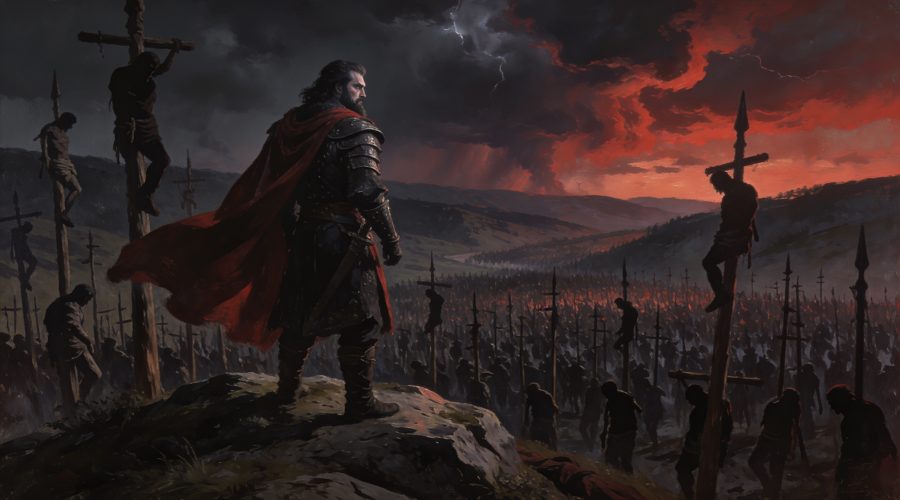
According to Chalkokondyles, who had access to Ottoman survivors of the campaign, the field stretched roughly seventeen stades long and seven stades wide — about three kilometres by 1.3 kilometres. Across that area, anywhere between 20,000 and 23,884 stakes had been driven into the ground. On each stake was the body of an Ottoman soldier or Bulgarian civilian Vlad had captured during his earlier raids and the more recent retreat. The largest stake reportedly held the body of Hamza Bey, the envoy.[14]
Birds had nested in the chests of the dead. The smell, the chronicler notes, could be detected for miles before the visual.
Mehmed II — a man who had personally ordered tens of thousands of executions, who had filled the streets of Constantinople with corpses nine years earlier — rode through the field in stunned silence. Chalkokondyles records his words:
“It is not possible to deprive of his country a man who has done such great deeds, who has such a diabolical understanding of how to govern his realm and its people.”
The Sultan ordered his army to dig defensive trenches around its camp that night. The next day, 22 June, he turned the army around and went home.[12]
Vlad III had done what no other ruler in southeastern Europe had managed since 1453. He had stopped the Ottoman war machine — and he had done it through information warfare, scorched-earth logistics, and a single, monstrous act of theatrical violence that broke the morale of the most disciplined army in the world.
VII — Betrayal, Imprisonment, and the Quiet Years
Vlad’s victory was, almost immediately, undone by his own allies.
His brother Radu — now in his late twenties, sophisticated, fluent in Ottoman politics, and very much the candidate Mehmed preferred — was already in Wallachia at the head of a smaller, second Ottoman force. While Vlad had been winning the strategic confrontation, Radu had been quietly buying off the very boyar class Vlad had spent years terrifying. By August 1462, much of Wallachia’s nobility had defected to Radu.[15]
Vlad fled north into the Carpathians, hoping for the support of his nominal ally Matthias Corvinus, the King of Hungary. What he received instead was an arrest warrant.
The reasons remain debated. Matthias had taken sizeable papal funds intended for an anti-Ottoman crusade and had not used them for that purpose; some historians suspect he produced forged letters supposedly showing Vlad allied with the Sultan to justify keeping the money for himself. Whatever the truth, Vlad was imprisoned in 1462 and would remain in Hungarian custody for roughly twelve years.[1]
Conditions were harsh at first — likely in the Visegrád fortress — but appear to have softened substantially over time. By the early 1470s, Vlad had reportedly converted to Roman Catholicism (a condition of his eventual release), married a relative of Matthias Corvinus (probably Ilona Szilágyi), and was living in a house in the Hungarian capital. He had, at minimum, two sons.[16]
VIII — The Final Reign and the Honeyed Head
Released in the summer of 1475, Vlad spent his last full year fighting alongside Matthias Corvinus and Stephen the Great of Moldavia in Bosnia, where — somewhat predictably — he resorted again to mass impalement of captured Ottomans.[1]
In November 1476, with Hungarian and Moldavian backing, Vlad reclaimed the Wallachian throne for the third time. The reign lasted weeks. As soon as the allied armies withdrew, Basarab Laiotă — a pro-Ottoman rival — returned with Ottoman support.
The end came in late December 1476 or very early January 1477, in an ambush somewhere south of Bucharest, possibly near Snagov or Comana. The exact circumstances are disputed. The most common version: Vlad and a small escort were caught between Ottoman cavalry and Basarab’s boyars, and fell in the fighting. A more dramatic version, recorded by the Russian envoy Fyodor Kuritsyn (who interviewed Vlad’s family afterward), holds that Vlad was killed by his own men in the chaos of battle — his troops mistaking him for an Ottoman because, in keeping with his usual practice, he was wearing a Turkish disguise.[17]
His head was cut from his body, packed in a barrel of honey to preserve it on the long journey, and sent to Constantinople. Mehmed II had it placed on a stake above the city gates as proof, finally, that Vlad III Dracula was dead.[18]
Vlad was about forty-five years old.
Vlad III Dracula: The File
| Born | Late 1431, probably Sighișoara, Transylvania |
| Father | Vlad II Dracul, Knight of the Order of the Dragon |
| Held hostage | 1442–1448, Ottoman court of Sultan Murad II |
| Reigns of Wallachia | 1448 (months); 1456–1462 (the famous reign); 1476 (weeks) |
| Posthumous epithet | Țepeș — “the Impaler” |
| Most famous battle | Night Attack at Târgoviște, 17 June 1462 |
| Self-reported kill count (1462 Bulgarian campaign) | 23,884 (in his own letter to Matthias Corvinus) |
| Total estimated victims (all reigns) | 40,000–100,000 — figures hotly debated |
| Died | Late December 1476 / early January 1477, near Snagov |
| Fate of head | Preserved in honey, sent to Constantinople, displayed on a stake |
| Fictional descendant | Count Dracula, in Bram Stoker’s 1897 novel (name only) |
IX — The Saxon Press: How a King Became a Monster
While Vlad was dying in Wallachia, his reputation was being permanently rewritten in the printing presses of southern Germany and Austria.
The Transylvanian Saxons — German-speaking merchants of the cities of Brașov and Sibiu — had every reason to hate him. He had raided their territories repeatedly during his second reign. He had impaled their merchants. He had, on at least one occasion, attacked an entire Saxon market town in revenge for a trade dispute. Now, with Vlad dead and Gutenberg’s press newly available, the Saxons had both the motive and the means to make sure the rest of Europe heard their version of the story.[19]
Between 1488 and the end of the fifteenth century, at least thirteen separate German-language pamphlets describing Vlad’s atrocities were printed in Nuremberg, Bamberg, Augsburg, and Strasbourg. They were, by the standards of the new printing trade, runaway bestsellers — partly because of the lurid content, partly because they slotted neatly into existing anti-Ottoman propaganda, and partly because they were among the very first books anywhere designed for popular sale rather than scholarly use.[19]
What appears in these pamphlets is, by modern standards, a mixture of recorded fact, exaggerated atrocity, and outright invention. Vlad almost certainly did impale large numbers of people. He did burn villages and raid Saxon towns. He probably did stage at least some of the more theatrical acts attributed to him. He probably did not, however, host a banquet inside a forest of his own corpses, dip his bread in their blood, and force surviving guests to do the same — as one popular pamphlet claimed.[7]
This is, in a real sense, one of the earliest documented examples of “fake news” in European history: politically motivated print propaganda, mass-produced for popular consumption, in which true atrocity is dressed up with fabricated atrocity until the line between them becomes irretrievable.
X — Hero in Bucharest, Monster in Berlin
The strange afterlife of Vlad III is that, while Western Europe inherited the Saxon version of him, Romania built a different one.
Romanian chronicles and folklore — beginning in the seventeenth century but accelerating dramatically with the nineteenth-century rise of Romanian nationalism — preserved a Vlad who was strict but just, who hung a golden cup at a public well in Târgoviște that no thief dared steal, who punished only the corrupt, who defended his peasantry against rapacious boyars, and who, above all, kept the Ottomans out.[20]
Romanian poets — Mihai Eminescu, Dimitrie Bolintineanu, Ion Budai-Deleanu — celebrated him as a symbol of national resistance. Communist Romania, under Nicolae Ceaușescu, made the celebration explicit: Vlad was officially a state hero, his statues went up across the country, and his unmarked supposed tomb at Snagov became a place of national pilgrimage.
In a 1999 nationwide poll, Romanians ranked Vlad among the most important figures in their country’s history. As recently as 2019, surveys showed his favourability rating in Romania remained high.[21]
The reason is not, in the main, denial. Romanians know what he did. The reason, rather, is that the alternative to Vlad — in their reading — was foreign domination. Wallachia was very small. Its enemies were very large. Vlad was, with all his cruelties, the ruler who managed to keep it independent in an era when independence was being lost everywhere else.
This is an uncomfortable kind of historical judgement. It is not, however, a stupid one.
XI — The Stoker Footnote
Bram Stoker’s 1897 novel Dracula is the reason most people in the English-speaking world have ever heard of Vlad. The connection between the historical man and the literary vampire, however, is far thinner than popular culture assumes.
Stoker never visited Romania. He did not read Romanian or speak any of the relevant Eastern European languages. The name “Dracula” reached him through a single brief footnote in a book he found in the public library at Whitby in 1890 — William Wilkinson’s 1820 An Account of the Principalities of Wallachia and Moldavia, in which the name is glossed as “devil.” Stoker liked the name. He used it.[22]
The character he built around the name was assembled from English Gothic tradition, Eastern European folk vampire lore, the personality of his employer (the actor Henry Irving), and a small amount of contemporary travel writing. The resulting Count Dracula has nothing in common with the historical Vlad III beyond a name and a vague Carpathian setting.[23]
The full conflation of the two — the modern, popular idea that Vlad III was the “real Dracula” — is largely the work of a single 1972 book by Radu Florescu and Raymond McNally, In Search of Dracula. Florescu and McNally were academic historians; their work on Vlad himself remains valuable. Their argument that Stoker drew specifically on Vlad’s biography, however, is now considered overstated by most Stoker scholars.
Vlad III did not need to be a vampire. He had, on his own terms, already been frightening enough.
Coda — What Vlad Actually Represents
The most useful way to read Vlad III is not as a monster, and not as a hero, but as a piece of evidence about what the late medieval state was actually willing to do when its survival was at stake.
Vlad ruled a small, agricultural principality in the most dangerous decade of southeastern European history. He had no standing army worth the name, an aristocracy that had murdered his family, an Ottoman Empire absorbing the Balkans wholesale, and a Hungarian crown that would eventually arrest him as a political convenience. The conventional tools of fifteenth-century statecraft — diplomacy, dynasty, gold — were either unavailable to him or had already failed.
What he had was the willingness to do things other rulers would not. Whether you read that as cruelty, calculation, or the brutal practicality of the genuinely cornered, depends on which century you are reading him from.
What is harder to deny is that, for a brief and terrible moment in June 1462, his strategy worked. The largest army on earth turned around and went home. A small, doomed principality survived, in some form, for another fifty years. The cost was a forest. The dividend was independence.
Whether that was a fair price is, in the end, the question we have been arguing about for five hundred years — and will probably argue about for five hundred more.
That, perhaps, is the truest measure of how much Vlad mattered. The terrible ones we forget. The interesting ones we cannot stop thinking about.
References
- “Vlad the Impaler.” Wikipedia — comprehensive synthesis of medieval and modern sources, including Chalkokondyles, Tursun Beg, and Florescu/McNally. Link
- “Vlad the Impaler.” Encyclopaedia Britannica, updated 2025. Link
- Florescu, Radu R. & McNally, Raymond T. Dracula: Prince of Many Faces — His Life and His Times (Boston: Little, Brown, 1989), Chapters 2–3 on the Ottoman captivity period.
- Treptow, Kurt W. Vlad III Dracula: The Life and Times of the Historical Dracula (Center for Romanian Studies, 2000) — the most rigorously sourced modern English-language biography.
- “Vlad III the Impaler.” EBSCO Research Starters. Link
- Cantacuzino Chronicle (17th century, drawing on earlier Romanian oral and written sources). The Easter feast and Poenari forced labour episode is reported in multiple Romanian sources but is not corroborated in surviving Ottoman or Saxon material.
- Treptow, Kurt W. (ed.) Dracula: Essays on the Life and Times of Vlad Țepeș (East European Monographs, 1991) — collected scholarly essays addressing the reliability of the German pamphlet tradition.
- Niccolò Modrussa, papal legate’s description of Vlad, c. 1460s — Italian eyewitness account of Vlad’s appearance and bearing during his Hungarian imprisonment.
- Konstantin Mihailović, Memoirs of a Janissary (late 15th century) — Serbian Janissary’s contemporary account of Ottoman-Wallachian relations. The “nailed turbans” episode, while popular, is not in the strongest contemporary sources and may be a later embellishment.
- Laonikos Chalkokondyles, The Histories (Books VIII–IX), late 15th century — the principal Greek-language contemporary source for the 1462 campaign.
- Tursun Beg, The History of Mehmed the Conqueror, late 15th century — Ottoman court chronicler who personally accompanied Mehmed’s army in 1462.
- “Night Attack at Târgoviște.” Wikipedia — synthesis of Chalkokondyles, Tursun Beg, and modern military analyses. Link
- Casualty estimates from Florescu & McNally, Dracula: Prince of Many Faces (1989), p. 142 — derived from Chalkokondyles and modern reconstructions.
- Vlad’s letter to Matthias Corvinus, 11 February 1462. The original survives in the State Archives of Hungary; an English translation is widely available in Treptow (1991, 2000) and Florescu/McNally (1989).
- Florescu & McNally, Dracula: Prince of Many Faces, Chapter 8 on Radu cel Frumos and the boyar defection of 1462.
- “Vlad the Impaler” — Wikipedia, sections on captivity and final reign, drawing primarily on Treptow and Florescu/McNally.
- Fyodor Kuritsyn, The Tale of Dracula Voivode (c. 1486) — Russian envoy who interviewed Vlad’s surviving family. Major early source for the death-by-friendly-fire account.
- “How Did Vlad the Impaler Die?” History Cooperative, 2025. Link
- German pamphlet collection, 1488–1499 (Nuremberg, Bamberg, Augsburg, Strasbourg editions). Surviving copies held principally in the British Library and the Bavarian State Library; reproduced in Treptow (1991).
- Giurescu, Constantin C. The History of the Romanians (Bucharest, 1937, multiple editions) — classic Romanian-perspective account of the Wallachian rulers.
- “Vlad the Impaler: Life, Death & the Dracula Connection.” HistoryExplained.org. Link
- Wilkinson, William. An Account of the Principalities of Wallachia and Moldavia (London: Longman, 1820) — the obscure travel book in which Stoker found the name “Dracula” in a footnote.
- Miller, Elizabeth. Dracula: Sense and Nonsense (Desert Island Books, 2000) — definitive modern study of what Stoker actually drew from, and what he didn’t.
Further reading:
Dracula, Prince of Many Faces: His Life and His Times by Radu R. Florescu & Raymond T. McNally
Vlad the Impaler: In Search of the Real Dracula by M.J. Trow
Vlad III Dracula: The Life and Times of the Historical Dracula by Kurt W. Treptow
Note: Some of the links above are affiliate links. If you make a purchase through them, I may earn a small commission at no extra cost to you. Thank you for supporting Decoding History.
Decoding History — delivered to your inbox.
Subscribe for free and you’ll be the first to know when our debut ebook — 5 Stories That Changed Everything & Got Erased — launches. No spam. Just history, decoded.
Subscribe Now