
Adolf Hitler died in a Berlin bunker on April 30, 1945. The men who had built his rockets, run his aviation medicine programs, and engineered his chemical weapons did not. They surrendered to the U.S. Army in Bavaria, were debriefed in mountain hotels, and within months were on flights to Texas. Their files carried a paper clip — the Army’s mark for cases the rules no longer applied to. The program was called Paperclip, and for the architects of the Nazi war machine, it was the closest thing to amnesty the twentieth century produced.
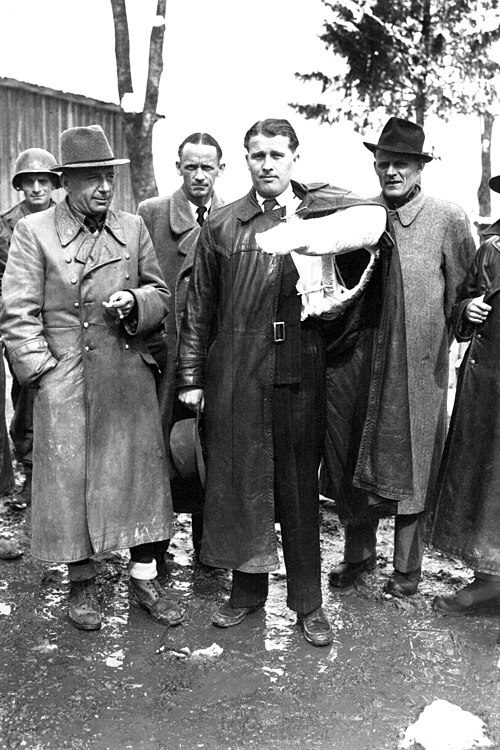
On May 2, 1945, in the Austrian alpine resort of Reutte, a 33-year-old SS officer with his arm in a plaster cast walked downhill toward an American counterintelligence checkpoint of the 44th Infantry Division. His name was Wernher von Braun. He had spent the war designing the V-2 ballistic missile — the world’s first long-range guided weapon — at Peenemünde. Production took place at the underground factory at Mittelwerk, where roughly 20,000 concentration camp prisoners died building rockets that killed civilians in London and Antwerp.[1] Von Braun was photographed grinning. Within four months, he was on American soil.
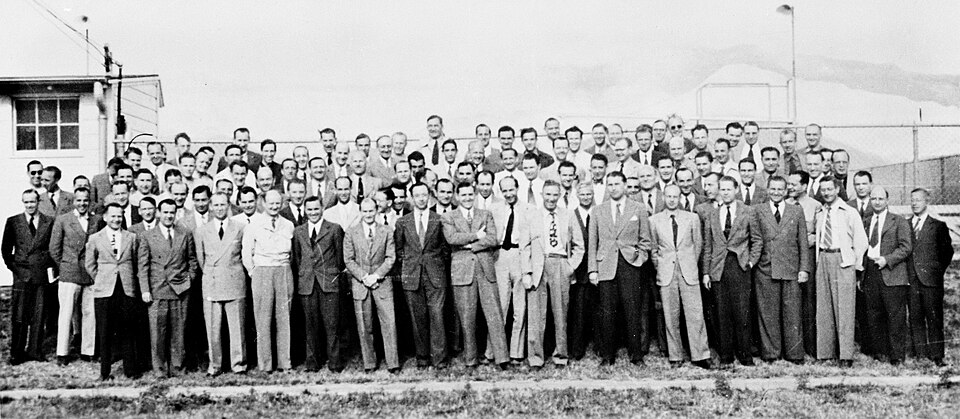
What von Braun walked into was not a tribunal. It was the opening phase of the most consequential intelligence operation of the early Cold War: the deliberate, organized recruitment of Adolf Hitler’s scientific establishment by the United States government. More than 1,600 German scientists, engineers, and technicians eventually crossed the Atlantic under the program.[2] Some had been nominal Nazis; many had been ardent ones. Several were complicit in war crimes the Nuremberg tribunals were prosecuting in real time.
The official codename was Operation Paperclip — a clerical detail that became a euphemism for the entire enterprise. The clip, attached by Army Ordnance Corps officers to the file folders of scientists they wanted, signaled that incriminating biographical material had been removed and replaced.[3] What follows is the documented history of how the program began, who it brought to America, and what the United States chose not to know about the men it was hiring.
I — The Surrender at Reutte
The senior leadership of the Peenemünde rocket program had been planning their surrender for months. By late 1944, von Braun and his colleagues understood that Germany was finished. The decisive question was which Allied army they would surrender to. Soviet forces, they expected, would take their knowledge at gunpoint. British capabilities offered less money and less ambition for missile development. American forces, in contrast, possessed both — and a documented appetite for German technology.[4]
In February 1945, von Braun moved his core team south from Peenemünde toward the Bavarian Alps. Crucial blueprints, including plans for the projected A-9/A-10 intercontinental missile, were hidden in a salt mine near the town of Dörnten.[5] The cache would later become the bargaining chip that set the terms of his American future. By April, the team had reached Garmisch-Partenkirchen. Von Braun himself had been injured in a car accident, hence the cast that appeared in the Reutte surrender photographs.
The Bargaining Position
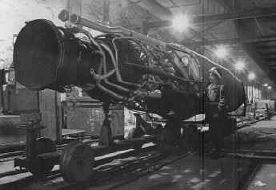
What von Braun offered the Americans was not just himself. It was a network — more than a hundred senior engineers, the design records of the V-2, the staff of the Peenemünde test facility, and the tooling at Mittelwerk. American forces had already begun dismantling the underground factory. By late May 1945, U.S. Army Major William Bromley’s Special Mission V-2 had loaded the components for one hundred V-2 missiles onto 341 railroad cars and shipped them out of the Soviet zone with hours to spare.[6] The hardware was already on its way to White Sands, New Mexico. The men were the next acquisition.
II — The Bargain in the Bavarian Alps
The institutional decision to bring German scientists to the United States was made under extraordinary pressure and without serious public debate. On July 19, 1945, the Joint Chiefs of Staff authorized Operation Overcast — the original name for what would become Paperclip — to manage the captured rocket personnel.[7] The program’s stated purpose was twofold: assist in the ongoing war against Japan, and prevent German expertise from falling into Soviet hands.
Japan surrendered on September 2, 1945. The first justification disappeared overnight. The second hardened. By late summer, the Joint Chiefs had established the Joint Intelligence Objectives Agency, or JIOA, a subcommittee that included representatives of Army, Navy, and Air Force intelligence plus a State Department officer.[2] The JIOA would run Paperclip for the next seventeen years.
In November 1945, Ordnance Corps officers reviewing files in occupied Germany hit on the device that gave the program its eventual name. When they encountered a scientist whose record contained Nazi Party membership, SS rank, or other disqualifying material, they attached a paper clip to the folder. The clip flagged the dossier for sanitization — the removal or rewriting of biographical material that would have barred the scientist from a U.S. visa.[3] By March 1946, the entire operation had been redesignated Paperclip.
III — The Truman Order, and the Way Around It
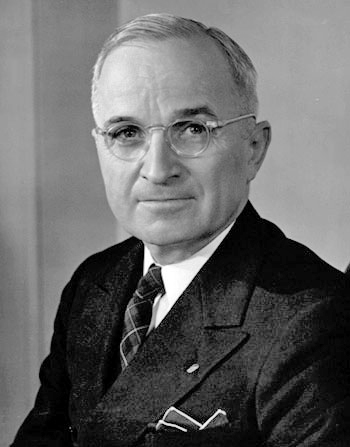
President Harry S. Truman issued his formal authorization for the program in August 1945. The order was unambiguous on one point: it expressly excluded anyone “found to have been a member of the Nazi Party, and more than a nominal participant in its activities, or an active supporter of Nazi militarism.”[8] Under those criteria, most of the men the JIOA wanted were ineligible.
Wernher von Braun had joined the Nazi Party in 1937 and the SS in 1940, eventually reaching the rank of Sturmbannführer (major). Arthur Rudolph, the operations director at Mittelwerk, had been a party member since 1931 — earlier than most. Hubertus Strughold had served as the chief of aeromedical research for the Luftwaffe. Kurt H. Debus, who would later become the first director of the Kennedy Space Center, was a former SS member.[9] Each had been categorized in earlier U.S. Army assessments as a security threat. None should have qualified.
Falsified Files
The JIOA’s solution was administrative. Officers reviewed the OMGUS denazification dossiers held by U.S. military government in Germany, noted the disqualifying entries, and rewrote them. Party memberships were downgraded from “ardent” to “nominal.” SS service was reframed as honorary or coerced. Witness statements describing concentration-camp visits or use of slave labor were quietly omitted. The State Department’s representative on the JIOA, Samuel Klaus, repeatedly demanded thorough background checks and was widely suspected of slow-rolling visas to obstruct the program.[10] He lost. By late 1947, the State Department, citing Cold War urgency, was issuing visas to JIOA designees.
News of Paperclip leaked into the American press in December 1946. Public reaction included open protest from Albert Einstein, who wrote to Truman, and from Eleanor Roosevelt, who used her syndicated newspaper column to question the recruitment of Nazis.[11] The protests were noted and ignored. Truman issued a secret expansion directive on September 3, 1946 — Directive SWNCC 257/22 — increasing the program’s authorized scope to roughly 1,000 specialists under “temporary, limited military custody.”[7]
The JIOA’s circumvention of the Truman order is documented in declassified files from the U.S. State Department’s Office of the Historian (Foreign Relations of the United States, 1946, Vol. V). The September 3, 1946 directive, SWNCC 257/22, formalized “temporary, limited military custody” for German specialists and bypassed normal immigration screening. Annie Jacobsen’s 2014 book Operation Paperclip, drawing on Freedom of Information Act releases, identifies specific cases where dossier language was rewritten by the JIOA in 1947–48 to make scientists eligible for visas.
IV — The Rocket Men of Fort Bliss
The first cohort of seven German rocket scientists arrived at Fort Strong on Long Island, in Boston Harbor, in September 1945. Von Braun was among them. By February 1946, 118 specialists from his Peenemünde team were installed at Fort Bliss, in El Paso, Texas, with a smaller subgroup at the White Sands Proving Ground in New Mexico.[12] Their official designation was “War Department Special Employees.”
At Fort Bliss the Paperclip men reassembled the V-2 components shipped from Mittelwerk and began launching them on American soil. The first U.S. test of a captured V-2 took place on April 16, 1946. By October of that year, an instrumented V-2 launched from White Sands had taken the first photograph of Earth from space — at an altitude of about 65 miles.[13] The same machine that had killed civilians in Antwerp and London eighteen months earlier was now an American research tool.
From El Paso to Huntsville
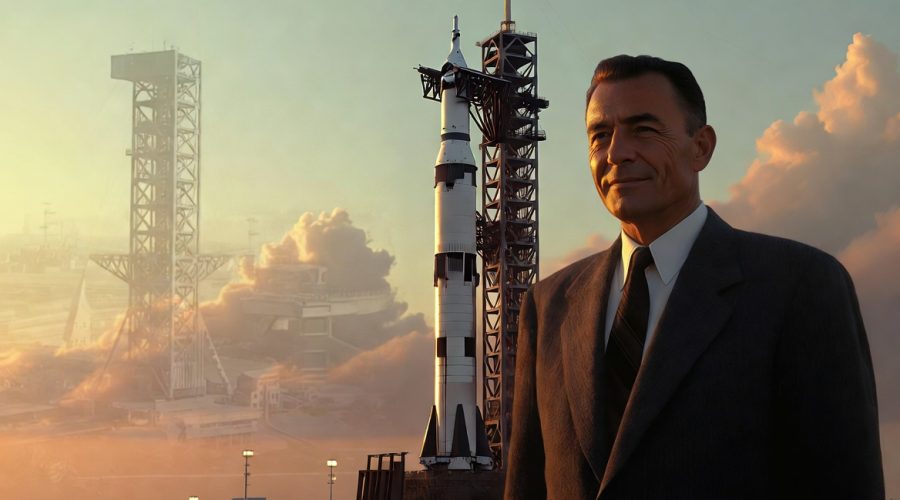
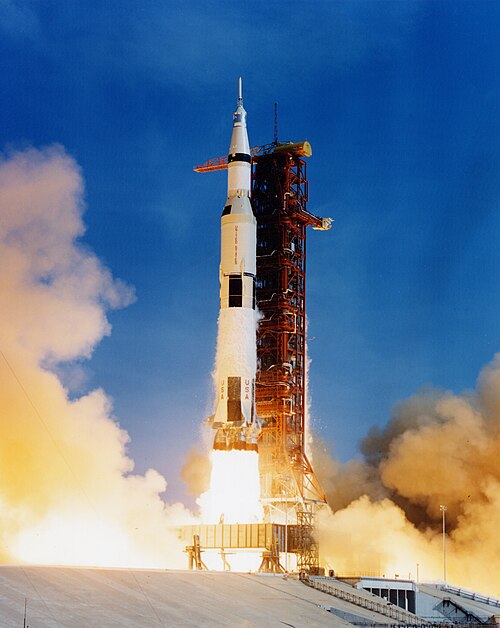
In April 1950, the Fort Bliss operation was transferred to the Redstone Arsenal in Huntsville, Alabama. Von Braun and roughly 130 of his Paperclip colleagues moved with it.[2] Huntsville became, in effect, a small German industrial town inside the American South. Von Braun would direct the development of the Redstone, Jupiter, and ultimately the Saturn V launch vehicles. In 1960, when NASA established the Marshall Space Flight Center in Huntsville, von Braun became its first director. On July 16, 1969, the Saturn V — designed under his leadership — lifted the Apollo 11 crew toward the moon.
The trajectory from Peenemünde to Tranquility Base ran through Operation Paperclip. Whether that trajectory could have happened without the German team is a contested question among historians; Michael J. Neufeld of the Smithsonian National Air and Space Museum has argued that the Paperclip rocketeers saved the U.S. perhaps two to ten years of research, but that American capacity in rocketry would have grown without them.[14] What is not contested is the moral arithmetic of the recruitment itself.
V — Mittelwerk and the Question of Knowledge
The factory where the V-2 was mass-produced had been carved out of a gypsum mountain in the Kohnstein, near the town of Nordhausen, after RAF bombers struck Peenemünde in August 1943. Mittelwerk’s tunnels stretched for kilometers underground. Its workforce came from the Mittelbau-Dora concentration camp, established as a satellite of Buchenwald in August 1943.[15] Roughly 60,000 prisoners passed through the camp; an estimated 20,000 died there, from beatings, hangings, exhaustion, starvation, and disease.
The casualty rate was higher than that of the V-2’s wartime victims. The rockets killed roughly 9,000 people in the United Kingdom, Belgium, and elsewhere.[15] The production process killed more than twice that number. Building the world’s first ballistic missile was, statistically, more dangerous than being on the receiving end of one.
What Von Braun Saw
Von Braun’s role at Mittelwerk has been disputed for decades. He visited the factory at least a dozen times between January 1944 and the war’s end. In a 1969 letter to a colleague that surfaced after his death, he described witnessing prisoners “in an appalling state.” He had been told, he wrote, that 250 slave workers were dying every day from overwork and malnutrition.[16] A separate document, dated August 15, 1944, captures him writing to a Mittelwerk colleague. The note confirms he had personally selected additional concentration camp prisoners from Buchenwald to expand the labor force. NASA’s own historical assessment now states that von Braun “was well aware of the terrible conditions and was involved in decision-making about the use of slave labor.”[17]
Arthur Rudolph’s case is sharper. As Mittelwerk’s operations director, he was directly responsible for the labor regime that built the V-2. After the war he became a senior NASA engineer; under his management, the Saturn V program produced the rocket that carried Apollo 11 to the moon. In 1984, the U.S. Office of Special Investigations confronted Rudolph with the documentary record. He renounced his American citizenship and returned to West Germany rather than face a war-crimes proceeding.[18] He was the only senior Paperclip rocket scientist ever to face that consequence. He died in 1996, never tried.
“Almost immediately, prisoners were forced to live underground, sleeping on straw spread on the bare stone floors of the tunnels. The dust from the gypsum was everywhere. Tuberculosis and other respiratory diseases spread like fire.”
The next investigation is already in production. Subscribe to get long-form, source-backed pieces like this one delivered before they go public.
Subscribe FreeVI — The Doctors’ Trial That Did Not Happen
While the Nuremberg Doctors’ Trial was prosecuting twenty-three German physicians for medical crimes between December 1946 and August 1947, the JIOA was actively recruiting men whose work had been entangled with the same research. The contradiction was not lost on observers at the time.
Hubertus Strughold had served as chief of aeromedical research for the Luftwaffe throughout the war. In that capacity, he had supervisory connections to a network of researchers conducting experiments at Dachau on subjects placed in low-pressure chambers and immersed in ice water — experiments that killed dozens. Strughold himself was not charged at Nuremberg, and historians remain divided on the precise extent of his personal involvement.[19] The U.S. Army Air Force concluded the question was unworth pressing. In August 1947, Strughold was brought to Randolph Field, near San Antonio, Texas, where he became the founding figure of American space medicine. The U.S. Air Force’s Aeromedical Library was named after him. The Space Medicine Association issued the Strughold Award annually from 1963 to 2013, when accumulating evidence of his Nazi-era role finally forced its discontinuation.[19]
The Schreiber Embarrassment
Walter Schreiber, the former Surgeon General of the German Army, came to the United States in 1951 under Air Force sponsorship. Within weeks the Boston Globe published a series alleging his connection to lethal medical experiments at Ravensbrück conducted by Dr. Kurt Blome.[20] The exposure was the first time the American public learned, in detail, what kind of men Paperclip had been bringing in. The Air Force did not cancel his contract. Instead, the U.S. military quietly arranged Schreiber’s emigration to Argentina, where he disappeared from the American press.
Kurt Blome himself, the deputy Surgeon General of the Reich and a senior figure in Nazi biological warfare research, was tried at Nuremberg as one of the twenty-three doctors. He was acquitted on what historians now consider thin grounds, and was promptly hired by the U.S. Army Chemical Corps in Camp King, Germany, in 1951 to consult on chemical and biological warfare.[21] He never crossed the Atlantic, but his name is on the Paperclip roster.
VII — The File Closes Slowly
By the early 1950s, Paperclip had been formally institutionalized inside U.S. national security policy. A successor program known as Project 63, launched in 1948, placed German specialists in private American defense contractors — Lockheed, Martin Marietta, North American Aviation — rather than the military directly.[22] Many Paperclip men obtained legal U.S. residency in early 1950 by exiting to Mexico and re-entering through the U.S. consulate in Ciudad Juárez, a procedure that allowed JIOA candidates to bypass standard immigration screening at Atlantic ports.
The Joint Intelligence Objectives Agency was disbanded in 1962 after seventeen years of operation. By that point, the formal Paperclip program had brought more than 1,500 German and Austrian specialists, plus their families, into permanent residence in the United States.[2] The figure of 1,600 frequently cited in popular accounts includes related programs and later arrivals through 1959.
The Records Open
The JIOA’s files were transferred to the National Archives, where most remained classified until the mid-1980s. The Office of Special Investigations, established in the U.S. Department of Justice in 1979, began systematic review of Paperclip cases and identified evidence sufficient to act against Arthur Rudolph in 1984. The Nazi War Crimes Disclosure Act of 1998 forced the broadest declassification of Paperclip-related material to date. Records of the Defense Department’s Foreign Scientist Case Files, Record Group 330, were opened progressively through the 2000s.[23] Tom Bower’s The Paperclip Conspiracy (1987) and Annie Jacobsen’s Operation Paperclip (2014) drew on this material to assemble the most detailed accounts to date.
“They closed the books on the past with a paper clip — a bureaucratic gesture so small it was almost invisible, and so consequential it would shape the American national security state for the next half-century.”
VIII — Operation Paperclip: The File
| Original codename | Operation Overcast (July 19, 1945) |
| Renamed | Operation Paperclip (March 1946) |
| Authorizing agency | Joint Intelligence Objectives Agency (JIOA), U.S. Joint Chiefs of Staff |
| Truman directive | SWNCC 257/22, signed September 3, 1946 |
| Operational dates | July 1945 – 1962 (JIOA dissolved) |
| Total specialists recruited | More than 1,600 (including family members, ~6,000)[2] |
| Primary research domains | Rocketry, aviation medicine, chemical and biological weapons, jet propulsion, electronics |
| Key destinations | Fort Bliss, TX; White Sands, NM; Wright Field, OH; Randolph Field, TX; Redstone Arsenal, AL |
| Notable recruits | Wernher von Braun, Arthur Rudolph, Hubertus Strughold, Kurt H. Debus, Walter Dornberger, Walter Schreiber, Reinhard Gehlen |
| Soviet counterpart | Operation Osoaviakhim (October 22, 1946) — relocated 2,200+ specialists to USSR |
| Public exposure | December 1946 (initial press); 1951 (Schreiber); 1984 (Rudolph); 1987 (Bower); 2014 (Jacobsen) |
| Records classification | Substantially classified until Nazi War Crimes Disclosure Act of 1998 |
| Only Paperclip scientist tried for war crimes | Georg Rickhey (Dora Trial, 1947 — acquitted) |
IX — Who Faced Justice, and Who Did Not
The accounting is short. Of the 1,600-plus specialists Paperclip brought to the United States, exactly one — Arthur Rudolph — was forced to relinquish his citizenship under threat of war-crimes prosecution. Georg Rickhey, the wartime general manager of Mittelwerk, was extradited to Germany and tried at the 1947 Dora Trial; he was acquitted. The remaining recruits lived out their lives as American citizens, many decorated with national medals, several with installations and awards bearing their names.[2]
Wernher von Braun received the National Medal of Science from President Gerald Ford in 1975. He died of pancreatic cancer in 1977 and was eulogized by President Jimmy Carter as a man whose name was “inextricably linked to our exploration of space.” Carter’s statement made no mention of the SS membership, the Mittelwerk visits, or the Buchenwald prisoner selections. Kurt Debus, the former SS officer, retired as director of the Kennedy Space Center in 1974 with a NASA Distinguished Service Medal. Hubertus Strughold’s name remained on Air Force facilities into the 1990s; the medical award named after him was retired only in 2013, decades after his death.[19]
The Other Trial — Adolf Eichmann
The asymmetry is sharper still when set beside the trajectory of those Nazis the United States did not recruit. Adolf Eichmann, who had organized the deportation logistics of the Holocaust, escaped to Argentina via a ratline operated outside U.S. channels. Israeli agents abducted him in 1960; he was hanged in Israel in 1962.[24] Eichmann had no scientific value. Von Braun had a great deal. The two men were roughly contemporaries; only one of them faced a courtroom.
Coda — Why It Still Matters
The title of this article is, strictly speaking, inaccurate. Hitler did not escape justice through Operation Paperclip. He died on April 30, 1945. What escaped through Paperclip was something more diffuse and arguably more significant: the technical and administrative core of his war machine. These were the men who had designed the rockets, supervised the medicine, run the chemical research, and managed the slave-labor factories. They were the apparatus that made Nazi militarism possible. They walked across the threshold of postwar accountability and into American university posts, government laboratories, and corner offices at NASA.
The defenders of Paperclip have always offered a cold-equation argument. Cold War tensions were real and rising. Meanwhile, the Soviet Union was conducting its own version of the program — Operation Osoaviakhim, which on the night of October 22, 1946, forcibly relocated more than 2,200 German specialists and their families to the USSR.[2] Had the United States declined to compete, the argument runs, Soviet missile and aviation programs would have advanced more rapidly. The consequences for global power, defenders argue, might have made later moral compromises larger rather than smaller.
The argument has force. It is also the argument the JIOA used to override Truman’s anti-Nazi directive, the State Department’s screening procedures, the Nuremberg precedent, and the protests of Einstein and Eleanor Roosevelt. It is the argument every national security state eventually arrives at when it wants something it knows it should not have. The question Paperclip leaves unanswered — and arguably unaskable inside the framework of the Cold War — is whether there was a different way. The historians who have looked closest, including Michael Neufeld of the Smithsonian, conclude that the German rocket team accelerated American work by a few years at most.[14] Two to ten years of advantage, in exchange for the suspension of justice for the architects of Hitler’s most lethal weapons.
The Mittelwerk tunnels are still there. So are the records of who built what, and on whose backs. The men who escaped through the paper clip are now long dead. The doctrine that produced their escape — that scientific value is a substitute for moral accountability when the geopolitical stakes are high enough — is not.
References
- Neufeld, Michael J. Von Braun: Dreamer of Space, Engineer of War. New York: Alfred A. Knopf, 2007. The standard biography. Documents the surrender at Reutte, von Braun’s Nazi Party membership (1937) and SS service (1940), and his role at Mittelwerk.
- “Operation Paperclip.” Wikipedia. Comprehensive synthesis citing primary sources including JIOA records and FRUS volumes. Link
- Jacobsen, Annie. Operation Paperclip: The Secret Intelligence Program That Brought Nazi Scientists to America. New York: Little, Brown & Company, 2014. The most extensive recent treatment, drawing on FOIA releases and German archives.
- Neufeld, Michael J. The Rocket and the Reich: Peenemünde and the Coming of the Ballistic Missile Era. New York: The Free Press, 1995. Standard scholarly account of the German rocket program.
- “Wernher von Braun.” NASA biographical entry. Documents the salt-mine document cache and surrender. Link
- “Mittelwerk.” Wikipedia. Details Special Mission V-2 and Major William Bromley’s evacuation of components on 341 railroad cars, May 1945. Link
- U.S. Department of State, Office of the Historian. Foreign Relations of the United States, 1946, Volume V. Documents the JIOA, SWNCC 257/22, and Truman’s September 3, 1946 directive. FRUS document
- “Project Paperclip.” Encyclopaedia Britannica. Cites Truman’s August 1945 order and exclusion language. Link
- “List of Germans relocated to the US via Operation Paperclip.” Wikipedia. Includes Nazi Party and SS membership data for individual scientists. Link
- Bower, Tom. The Paperclip Conspiracy: The Hunt for the Nazi Scientists. Boston: Little, Brown and Company, 1987. First major investigative book on Paperclip; documents Samuel Klaus’s resistance from inside the State Department.
- Crim, Brian E. Our Germans: Project Paperclip and the National Security State. Baltimore: Johns Hopkins University Press, 2017. Documents the December 1946 press exposure and the Einstein-Roosevelt protests.
- “Operation Paperclip at Fort Bliss: 1945–1950.” White Sands Missile Range Museum. Details first arrivals (Fort Strong, September 1945) and subsequent transfer to Fort Bliss. Link
- “V-2 rocket.” Wikipedia. Documents White Sands launches and the October 1946 first-photograph-from-space milestone. Link
- Neufeld, Michael J. “Project Paperclip and American Rocketry after World War II.” Smithsonian National Air and Space Museum. Argues for a moderate revisionist view of Paperclip’s actual technical contribution. Link
- “Mittelbau-Dora concentration camp.” United States Holocaust Memorial Museum Encyclopedia. Documents prisoner totals, mortality, and the V-2 production casualty figures.
- Sellier, André. A History of the Dora Camp: The Untold Story of the Nazi Slave Labor Camp That Secretly Manufactured V-2 Rockets. Chicago: Ivan R. Dee, 2003. Survivor account; cited for the eyewitness conditions inside Mittelwerk tunnels.
- “Wernher von Braun.” NASA biographical entry. NASA’s institutional acknowledgment of von Braun’s involvement with slave labor decisions. Link
- “Arthur Rudolph.” Wikipedia. Details the 1984 Office of Special Investigations confrontation, Rudolph’s renunciation of citizenship, and his return to West Germany. Link
- “Hubertus Strughold.” Wikipedia. Documents Strughold’s Luftwaffe role, Randolph Field placement, and the 2013 retirement of the Strughold Award by the Space Medicine Association. Link
- Hunt, Linda. Secret Agenda: The United States Government, Nazi Scientists, and Project Paperclip, 1945 to 1990. New York: St. Martin’s Press, 1991. Reconstructs the 1951 Schreiber exposure and the Air Force’s response.
- “Kurt Blome.” Wikipedia. Documents the Nuremberg Doctors’ Trial acquittal and the subsequent Camp King contract. Link
- “Project 63” and follow-on Paperclip programs. Cited in Crim (2017) and Hunt (1991); contextual coverage on private-sector placements at Lockheed, Martin Marietta, and North American Aviation.
- National Archives and Records Administration. “Records of the Secretary of Defense (RG 330): Personnel dossiers on over 1,500 German and other foreign scientists, technicians, and engineers brought to the United States under Project Paperclip.” Released under the Nazi War Crimes Disclosure Act of 1998. Link
- Bascomb, Neal. Hunting Eichmann: How a Band of Survivors and a Young Spy Agency Chased Down the World’s Most Notorious Nazi. Boston: Houghton Mifflin Harcourt, 2009. Standard recent account of the 1960 Mossad operation and the 1962 Israeli trial.
Further reading:
Operation Paperclip: The Secret Intelligence Program That Brought Nazi Scientists to America by Annie Jacobsen — the definitive modern account of how the U.S. recruited Nazi scientists, drawing on declassified files and FOIA releases.
The Paperclip Conspiracy: The Hunt for the Nazi Scientists by Tom Bower (1987) — the groundbreaking investigative exposé on the Allied race to seize German scientific expertise after WWII.
The Nazis Next Door: How America Became a Safe Haven for Hitler’s Men by Eric Lichtblau (2014) — Pulitzer Prize-winning account of how the United States provided refuge to Nazi war criminals after the war.
Note: Some of the links above are affiliate links. If you make a purchase through them, I may earn a small commission at no extra cost to you. Thank you for supporting Decoding History.
Decoding History — delivered to your inbox.
Subscribe for free and you’ll be the first to know when our next long-form investigation drops. No spam. Just history, decoded.
Subscribe Now
[…] in decades — is now familiar enough to readers of our earlier investigations. We saw it in Operation Paperclip’s absorption of Nazi scientists, in the Phoenix Program’s counterinsurgency in Vietnam, and in […]